

Meet Our Rising Star – Professor Ma Guancong, Faculty of Science
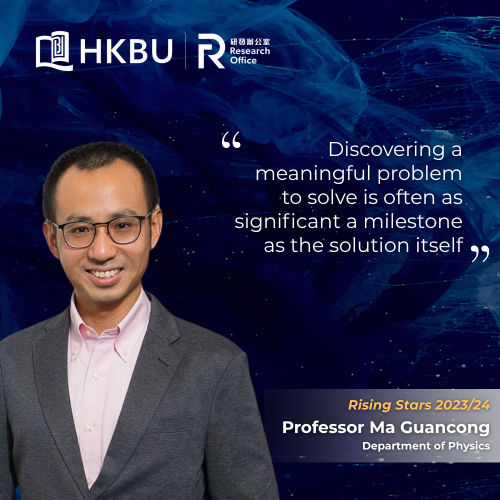
Professor Ma Guancong, Chair Professor in Physics and Metamaterials, is a researcher in topological physics, non-Hermitian physics, metamaterials, and complex waves, with over 40 peer-reviewed papers published in elite journals such as Science, Nature, and Physical Review Letters. His review of topological acoustics was featured in NatureResearch’s "40 years of the quantum Hall effect" collection.
Ranked among Stanford’s World’s Top 2% Scientists, Professor Ma now serves as a member of the Executive Committee of the Physics Society of Hong Kong.
The Research Office (RO) sits down with Professor Ma to look at his career and his current role shaping physics at HKBU.
RO: What are you currently working on?
Ma: My current research program is focused on the frontier of non-Hermitian topological physics and complex waves in classical wave systems. We are striving to revolutionise how we manipulate acoustic and light by moving beyond traditional constraints to develop more efficient, cutting-edge control mechanisms. The significance of this work lies in its disruptive potential. We are establishing a new paradigm for wave control that combines exceptional robustness with unprecedented flexibility. These advances are critical for the development of next-generation high-performance devices, particularly sensors and transducers.
RO: What initially drew you to the fields of topological and non-Hermitian physics?
Ma: I was drawn to this field by a combination of intellectual fascination and the thrill of bold experimentation. Initially, I was captivated by the unique phenomena of non-Hermitian physics; it shattered the rigid frameworks of classical physics and offered a radical new lens for understanding wave dynamics.
However, the true pull came from the challenge of execution. My team and I immersed ourselves in the laboratory for over 13 months, navigating countless failures to build a novel acoustic-vibration research platform from scratch. When our results were eventually published in Nature, it was more than just publication; it was validation from the international community. Seeing our work lead the field and inspire new research directions solidified my passion for exploring these complex physical frontiers.
RO: What do you see as the most exciting potential applications of your research in metamaterials and acoustics?
Ma: I envision the most transformative application to be in high-performance sensing and detection. Traditionally, sensor technology faces a fundamental trade-off: high sensitivity almost always comes at the cost of robustness and environmental compatibility. My research challenges this limitation.
By leveraging non-Hermitian physics as a novel degree of freedom, we can unite these typically conflicting qualities within acoustic metamaterials. This approach allows us to achieve vibration detection that is not only highly sensitive, but also exceptionally stable. We are effectively providing a new paradigm for wave manipulation. The practical implications are vast, ranging from sharper medical ultrasound diagnostics to next-generation underwater sonar systems capable of advanced anti-stealth detection. We are paving the way for devices that can "hear" with unprecedented precision in complex environments.
RO: Of your completed work at HKBU, which project holds the most meaning for you?
Ma: I am most proud of our work achieving efficient control over topological states using the non-Hermitian skin effect. We challenged the convention that topological states must be localised, realising during a team discussion that the skin effect could revolutionise how we manipulate these states.
Turning this hypothesis into reality required immense effort, but our excellent experimental results ultimately astonished international peers and garnered widespread recognition. We are now actively working to translate this innovative concept into practical applications, proving that our fundamental breakthrough can deliver real-world utility.
RO: What unique qualities of your research team most inspire and support you on your research journey?
Ma: What inspires me most is the cohesive and collaborative spirit of my team. I firmly believe that open, egalitarian discussion is the vital source of innovation and intellectual growth. Our laboratory culture is defined by vibrant daily exchanges that spark new ideas, underpinned by a work ethic that is both rigorous and resilient. My team members approach scientific challenges with tireless courage and a pioneering drive. This shared dedication creates a powerful synergy where we do not just conduct research: we grow, explore, and discover the unknown together.
RO: What's your go-to hobby, and how do you balance it with your job?
Ma: I am passionate about mountaineering, diving, and running. I view work and life as symbiotic: vigorous outdoor activity revitalises my body, while research sharpens my mind. Together, they fuel my enduring drive and enthusiasm for both discovery and daily life.
RO: What advice would you pass down to early-career researchers?
Ma: Research is rarely smooth; if it were, the question you are asking would very likely be trivial. Discovering a meaningful problem to solve is often as significant a milestone as the solution itself.