

Meet Our Rising Star – Professor Keri Hui, Academy of Music
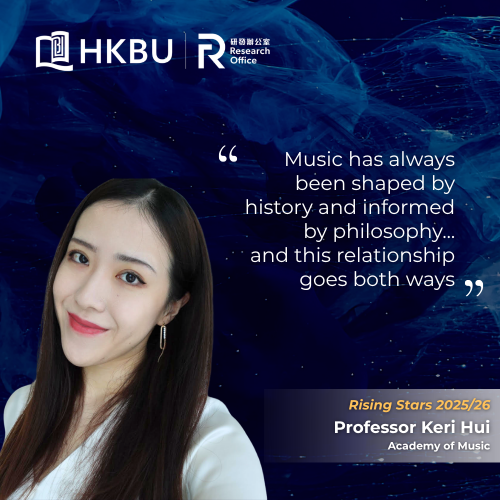
Assistant Professor Keri Hui grew up in an arts-loving home, starting piano at seven and violin at eight—the latter becoming her major at Idyllwild Arts Academy. When an injury forced her to stop playing, she explored visual art and poetry before earning a piano performance major and music industry minor at the University of Southern California (USC). Though she thrived in music business, her passion for performance drew her to London.
After her injury resurfaced, she pursued a joint PhD in musicology between King's College London and the University of Hong Kong—a reluctant shift that sparked a genuine love for music research and writing.
That winding journey now underpins her work at HKBU. Let's explore her broader research interests and projects beyond music.
Research Office (RO): What specifically about your areas of focus, such as 18th-century aesthetics and sensibility, first sparked your interest?
Hui: My doctoral work in musicology allowed me to branch out from music theory into philosophy, history, and aesthetics.
I realised that sensibility was a central concern of the Enlightenment, spanning many disciplines. Many historians today have moved beyond viewing the 18th century purely as the so-called “Age of Reason,” recognising it also as an age of sensibility. This realisation became the basis of my research: investigating how sensibility—this human capacity to feel both morally and aesthetically—interacted dynamically with music. It informed not only composition, performance, and listening, but also how music intersected with broader social, political, religious, and scientific contexts.
RO: What is the one thing you believe is the key to successful transdisciplinary research?
Hui: Grow your literacy in all the disciplines you engage with. Otherwise, empty rhetoric will one day catch up to you because (as in my case) arguments need to be grounded in actual historical contexts and philosophical frameworks. History and philosophy are not footnotes: music has always been shaped by history and informed by philosophy—especially in an Enlightenment context—and this relationship goes both ways. 18th-century historians and philosophers frequently drew ideas from music to articulate their own concepts and formulate their theories. Developing fluency across these fields is what allows them to illuminate one another.
RO: For those outside your field, how would you describe your funded project?
Hui: My project sits at the intersection of historical musicology, intellectual history, and philosophy. The big picture is to rethink how we understand Enlightenment thought and music by viewing them through a more interconnected lens.
When people think of the Enlightenment, they often assume two things: first, that it was purely a European, rationalist creation; and second, that it constructed a rigid, masculine archetype of pure reason while systemically feminising emotion and sensibility. My research complicates both assumptions. While 18th-century texts frequently used gendered language to describe reason and emotion, these instances do not tell a complete story. Language had its limits, and in many cases, music offered a dynamic space where these cultural and gendered relationships became far more complex.
In my project, I also evoke the term “global philosophy”—a phrase I actually hesitate to use because the word “global” can feel like an overused cliché. Yet even European Enlightenment thinkers were engaging with non-European sources, such as Chinese aesthetic thought, in ways that influenced ideas we now view as “Western,” even though their understanding of those cultures was limited. When I use the term, then, I am not trying to reduce diverse traditions into a uniform model. Instead, it is to acknowledge the importance of preserving cultural distinctiveness and pluralistic concepts, of examining power dynamics and cross-cultural interactions, and of tracing how these forces operated within musical contexts.
Relevant to this is the framework of ‘global aesthetics’ proposed by a contemporary aesthetician. As she emphasizes, the need for this term itself exposes a delusion: treating Western theory as the core discipline while dismissing non-Western perspectives as merely peripheral. Confronting this structural bias guards against Eurocentrism.
RO: Apart from your funded project, what is another research project you’d particularly like to highlight?
Hui: I would like to highlight an edited volume I am co-editing, tentatively titled Music and Sound in Negative Aesthetics and Metaphysics: East and West. This project brings together a wonderful group of contributors. What makes it special to me is working alongside co-editors who are likeminded friends and intellectual collaborators, combining musicology, sound studies, ethnomusicology, and philosophy.
We are hoping to connect two discourses on negative aesthetics: first, the emotional experience of aesthetic displeasure, such as disgust, noise, or ugliness; and second, negativity as absence, emptiness, or shock. The project offers a foundation for the “sonic ontologies” currently trending in sound studies and continental philosophy. By bringing Eastern and Western thought into conversation, it also shifts away from Eurocentric models of aesthetic theory, offering a more global, cross-disciplinary framework for how we process difficult, absent, or “negative” aesthetic experiences today.
RO: How has the environment at HKBU empowered you to pursue and deliver high-quality research?
Hui: The environment at HKBU has empowered my research in several ways, including, most importantly, generous institutional backing and a creative, collaborative community. First, the resource and funding support at HKBU have provided the stability and freedom needed to pursue projects, giving me both the time and the material means required to maintain focused research endeavours. Second, the vibrant atmosphere fostered by my colleagues brings distinct perspectives into our interdisciplinary discourse, creating an atmosphere that has been central to enlivening the quality and expanding the scope of my work.
Furthermore, the Academy of Music has a strong reputation for training exceptional musicians. As a musicologist with a background in performance, being surrounded by students and scholars who are gifted performers helps form possibilities for me to consider dialogue opportunities between scholarship and practice.
RO: If you could share just one piece of wisdom with the next generation of researchers, what would it be?
Hui: Hold strong convictions, but leave room for evolution. Imposing your views on others denies their agency and their sovereignty to seek the truth. Wisdom lies in trusting that the other person’s intellect – defined in my research through reason and sensibility – will guide them and remaining humble enough to accept that your own views may change along the way.