

A new chemotherapy strategy: dual-action osmium complex collapses cancer redox balance
.png)
Healthy cells maintain a tight redox balance between reactive oxygen species (ROS) and antioxidants such as glutathione (GSH). Cancer cells, by contrast, run chronically high ROS to fuel rapid growth and survive by upregulating antioxidant defences. Traditional chemotherapies try to tip this balance by either elevating ROS or depleting antioxidants, but tumours often adapt to these single-pronged attacks, leading to drug resistance and relapse.
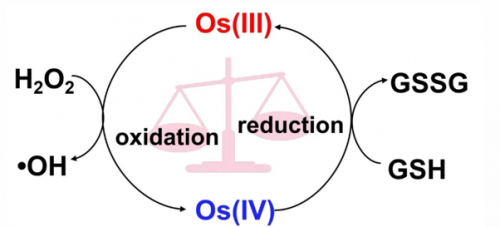
This work describes a dual-action, self-sustaining osmium redox couple that simultaneously amplifies reactive oxygen species and depletes glutathione in tumour cells, collapsing redox homeostasis to induce immunogenic cell death and activate systemic antitumour immunity in preclinical models.
To address this, Professor Man Wai Lun from the Department of Chemistry, together with Professor Ni Wenxiu and Professor Wei Xiaolong at Shantou University, have developed a dual-action, self-sustaining osmium catalyst system. Inside tumour cells, the reduced osmium species (OsIII) catalytically boosts ROS and converts to the oxidised form (OsIV). OsIV then rapidly consumes GSH, which simultaneously regenerates OsIII. The result is a continuous redox cycle that both amplifies oxidative stress and strips away antioxidant protection, trapping cancer cells in a lethal loop and driving multiple modes of cell death.
In mouse models, the outcome shows that this tumour destruction is immunogenic, priming the immune system to attack distant, untreated tumours. It demonstrates efficacy and tolerability in mice, opening a promising path to pair metal-based catalysis with immunotherapy as it progresses toward clinical trials.
These findings have been published in Advanced Science (Weinheim, Baden-Württemberg, Germany) under the title “A Catalytic Osmium Redox Couple Collapses Cancer Redox Balance”.

Professor Man’s research profile: Wai Lun MAN - Hong Kong Baptist University
This article was originally published by the Faculty of Science.