

HKBU scholars secure RMB 1.6 million in Shenzhen Medical Research Grants for cutting-edge health studies
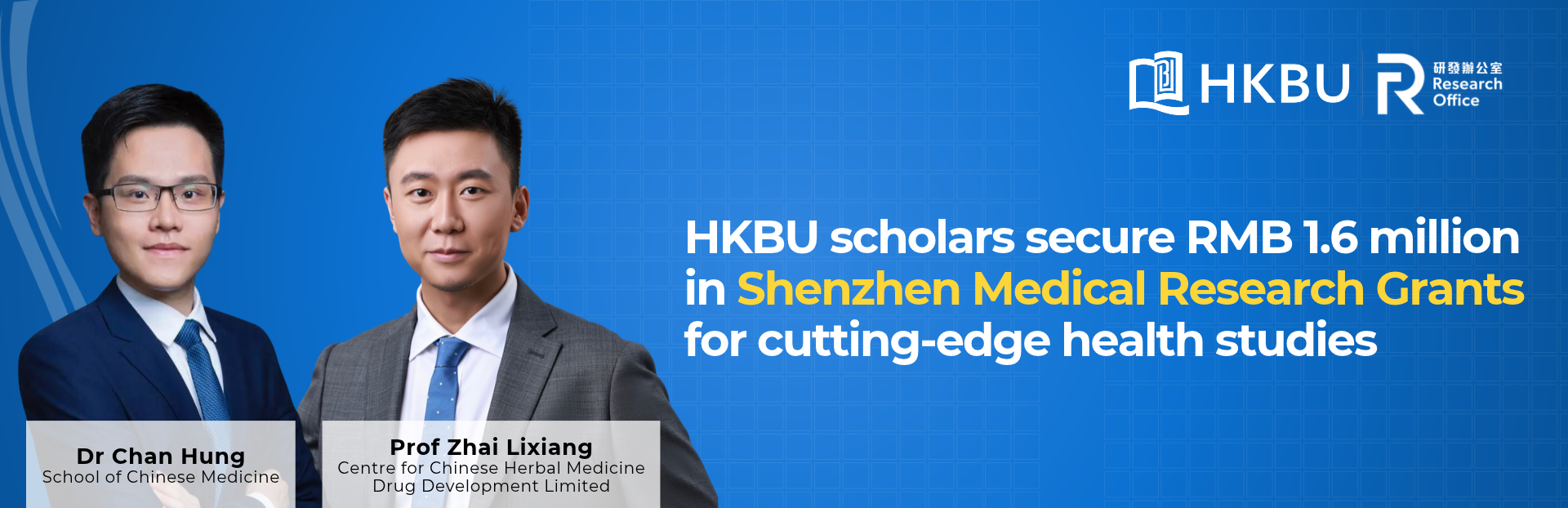
Hong Kong Baptist University (HKBU) is delighted to announce that two of its scholars, Professor Zhai Lixiang, Assistant Professor in the Centre for Chinese Herbal Medicine Drug Development Limited, and Dr Chan Hung, Research Assistant Professor in the School of Chinese Medicine, have secured a combined RMB 1.6 million in funding from the 2026 Shenzhen Medical Research Fund Project (深圳市醫學研究專項資金項目). Both projects, classified as "Talent Nurturing Type – Young Scientist Projects" (人才提升型 - 青年項目), are set to run from January 2027 to December 2029. This significant achievement underscores HKBU's commitment to advancing cutting-edge research with the potential to address pressing health challenges and nurture new research talents.
Professor Zhai Lixiang has been awarded RMB 800,000 for his project titled "Intestinal Barrier Dysfunction in Diarrhea-Predominant Irritable Bowel Syndrome: Pathogenic Mechanisms and Intervention Strategies Based on the 'Clostridia-Lithocholic Acid-LPCAT1' Axis". The research examines how 7α-dehydroxylating clostridia and their metabolite, lithocholic acid (LCA), contribute to intestinal barrier dysfunction, and finds that LCA upregulates LPCAT1, activating MMP1 and causing gut barrier damage. It also investigates glycocholic acid (GCA) as a potential therapeutic inhibitor for LPCAT1, aiming to provide novel insights and therapeutic strategies for IBS-D.
Dr Chan Hung's project, titled “Mechanistic Insight into the Adrenergic Stimulation of Fibroblasts Promotes CXCL3+ Macrophage Polarization in Psoriasis”, receives RMB 800,000 and investigates the mechanisms underlying psoriasis, a chronic inflammatory skin disorder often exacerbated by psychological stress. The study explores how adrenergic signalling triggered by stress activates stress-associated fibroblasts (SAFs), which then drive CXCL3+ macrophage polarisation, which exacerbates psoriatic inflammation. This research seeks to identify key molecular pathways within this SAFs-macrophage axis, offering a theoretical basis for developing precision treatment strategies for stress-sensitive inflammatory skin diseases.
Next News