

The privacy-first breakthrough that helped a city breathe again
In the spring of 2020, as the pandemic brought daily life to a halt across the globe, a team of university researchers in Hong Kong began working on an unlikely weapon: a contact tracing tool that would refuse to collect personal data. While most of the world assumed that fighting the virus required sacrificing privacy, this team bet on the opposite—and won.
Key Impacts:
Enabled privacy-first pandemic response at scale: Designed a contact tracing system that collects no personal or location data, building public trust and enabling citywide adoption
Shaped Hong Kong’s official contact tracing app: The government adopted the team’s decentralised model for LeaveHomeSafe, serving nearly 7 million residents securely
Pioneered on-device AI for automatic check-out: Used smartphone sensors to detect venue departures with >90% accuracy—no user input needed
Empowered citizens with real-time risk visibility: Delivered high-resolution hotspot maps in under 0.5 seconds, used daily by over 50,000 people
Accelerated safe societal reopening: Helped contain outbreaks faster, supporting earlier relaxation of restrictions and economic recovery
Earned international recognition: Named one of Asia’s Top 10 Digital Innovations by Times Higher Education Awards
Set a global standard for trustworthy health tech: Proved privacy and pandemic control can coexist—offering a blueprint for future crises
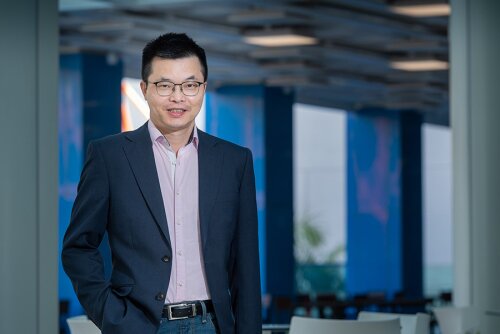
Led by Professor Xu Jianliang, Chair Professor and Head of the Computer Science Department at Hong Kong Baptist University (HKBU), the researchers understood that manual contact tracing was crumbling. The process was, as Professor Xu put it, "time-consuming and resource-intensive." Going digital offered a way to handle massive volumes of complex data more efficiently, but logic alone couldn't solve the deeper problem: trust had become brittle.
Hong Kong in 2020 was a place where privacy concerns carried a particular sting. The social unrest of 2019 had left many citizens deeply wary of how digital tools might be used. Looking abroad only confirmed their fears. Centralised systems on the Chinese mainland and Singapore raised alarms over data collection. “Even Bluetooth-based approaches in other countries stumbled, often requiring location permissions that felt invasive to a sceptical public,” Professor Xu says, adding that digital contact tracing posed an especially delicate challenge in Hong Kong, and a completely novel approach was necessary. So his team built one.
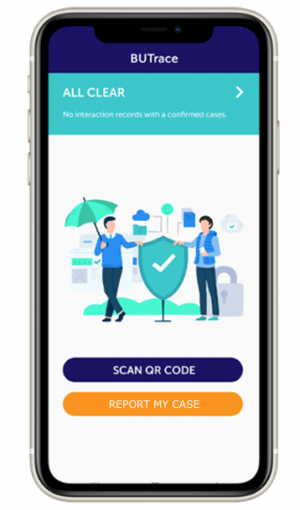
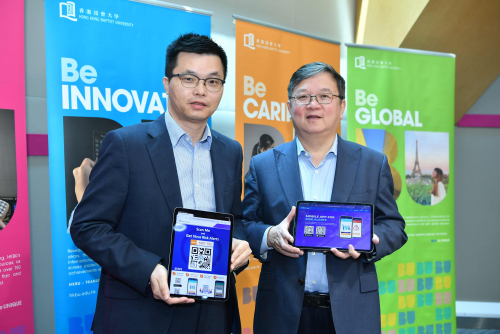
It shows the main interface of the BU-Trace app
HKBU's COVID-19 alert system integrates AI technology and uses NFC tags to facilitate logging of check-in and checkout times at venues [Photo courtesy: HKBU CPRO]
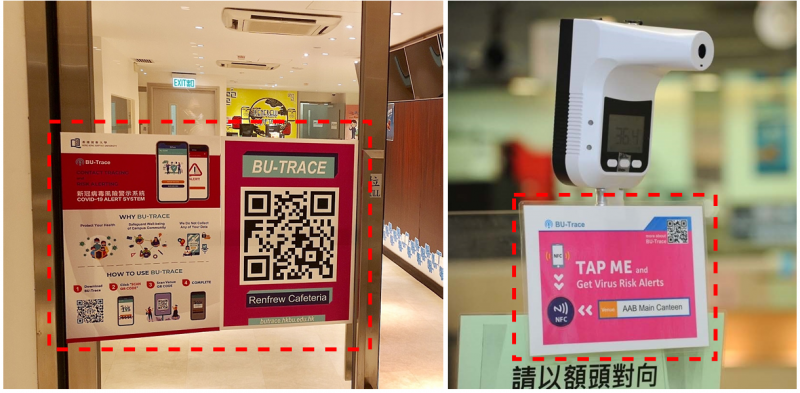
By April 2020, they had a prototype called BU-Trace. The system worked without permission requests, without GPS, and without central servers. “Instead, it used cryptographic identifiers and NFC technology to log venue visits. When a patient tested positive and needed to upload their travel history, only encrypted venue identifiers were sent to health authorities,” he says. Everything else—data storage, computation, and cross-checking—happened locally on the user's own device. This design, Professor Xu explained, protected privacy while improving scalability.
Most importantly for public adoption, the app eliminated the need for location access entirely. The strategy worked: user studies showed that alleviating privacy concerns could boost uptake by 35 percent.
The HKSAR government took notice. After months of collaboration, the official LeaveHomeSafe app launched in November 2020, built on the same decentralised model. Professor Xu made a point of reassuring the public that the system operated without network connectivity or central servers, and it collected no personal data or location information.
But the team didn't stop at check-ins. They added an AI layer to solve the subtle but persistent problem of people forgetting to check out. Using time-series accelerometer data from smartphones, the team developed an intelligent algorithm that could detect when a user left a venue physically. The feature worked across different phone models, and achieved over 90 percent accuracy in detecting departures. Eventually, around a million taxi passengers used it every day without even noticing the intelligence running underneath.
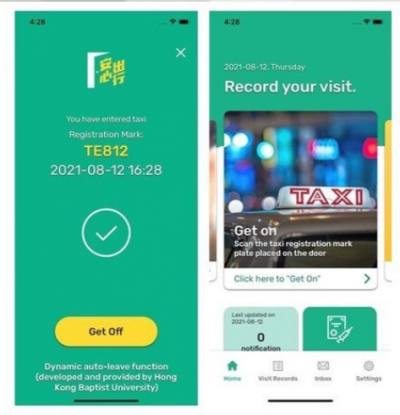
The display of HKBU’s AI-enhanced dynamic auto-leave function in LeaveHomeSafe
The impact rippled through the city. Seven million people—roughly the entire population of Hong Kong—benefitted directly from the system. The technology helped curb the virus and made it possible to resume economic activities sooner than would have been imaginable. International recognition followed: the Times Higher Education Awards Asia named it a top-ten digital innovation of the year, and local press called it a true breakthrough in contact tracing.
Yet the researchers knew that technology alone couldn't reach everyone. Some citizens simply wanted to see the risk with their own eyes. So, the team built COVID-19 Hotspot Maps that turned daily case data into high-resolution density heatmaps—far more informative than the government's red dots or text lists. “The maps handled millions of data points and rendered high-definition images in under half a second. More than 50,000 people visited them, using the maps to decide whether to visit a grocery store or avoid a particular neighbourhood,” Professor Xu says.Authorities used the visualisations to target resources where they were needed most.
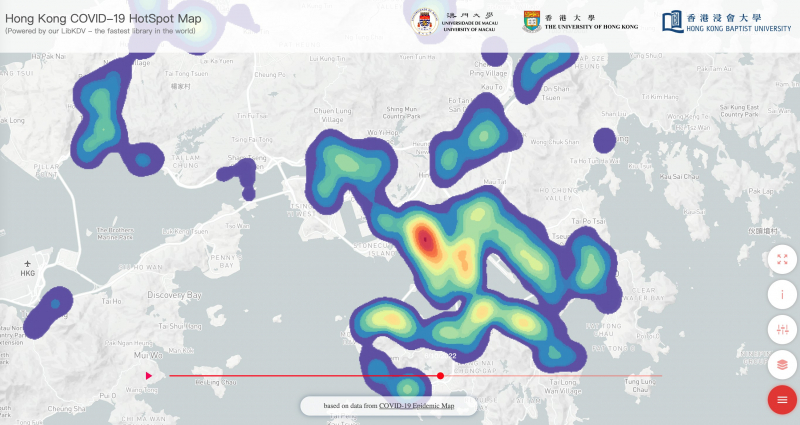
Hong Kong COVID-19 Hotspot Map allows the visualisation of real-time and dynamic geographic distribution of COVID-19 cases in Hong Kong.
In the end, what the researchers built was more than a contact tracing app. It was a secure, trusted framework for managing a historic crisis. Advanced AI and strict privacy protocols worked side by side, and as Professor Xu reflected, the work enabled faster containment, the gradual relaxation of social-distancing measures, and an orderly return to normal life.
Professor Xu's research profile: Jianliang XU - Hong Kong Baptist University