


Turning shale gas into a carbon sink: New study charts China’s pathway to geological negative emissions
A research team led by Professor Guo Meiyu at Hong Kong Baptist University (HKBU) has published a study in Nature Communications that reimagines the role of fossil fuel extraction in climate mitigation.
Titled "Carbon sequestration for geological negative emissions of the shale gas value chain in China," the paper shows how coordinated deployment of CO₂-based technologies can transform the nation’s shale gas value chain from a net emitter into a durable carbon sink.
Instead of focusing solely on incremental emission reductions at the wellhead, the study evaluates an integrated framework that embeds CO₂ across the entire value chain—combining CO₂-based hydraulic stimulation, CO₂ huff-and-puff enhanced gas recovery, and in-situ geological storage.
The authors find that synergistic deployment could deliver a national carbon sink of up to 66 billion tonnes of CO₂-equivalents while increasing shale gas production by about 4.5 trillion cubic meters. In lifecycle terms, the combined pathway achieves a negative carbon intensity of roughly −437 g CO₂e per cubic meter, with the nation’s Carbon Neutrality Coefficient above 110%, indicating net-negative operations on a cradle-to-grave basis.
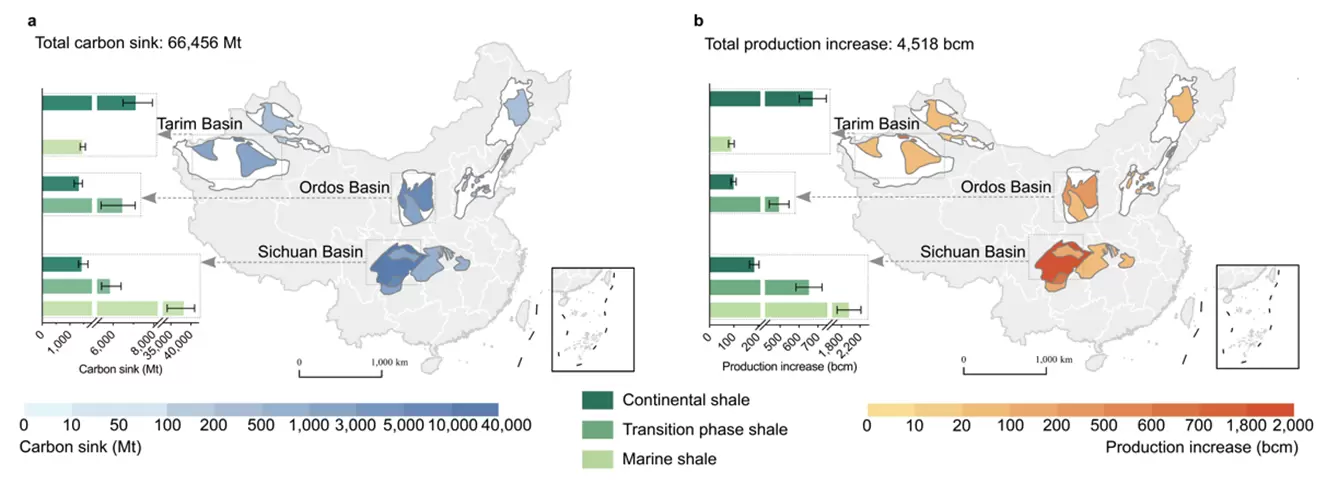
The study’s region-specific analysis highlights clear investment priorities. Marine shale in the Sichuan Basin shows inherent profitability, with an internal rate of return at around 20%. Continental reservoirs in the Tarim and Ordos Basins can achieve net-negative outcomes with tailored carbon credit integration, optimised field development strategies, or targeted incentives.
Importantly, the authors find that current prices in China’s carbon market are not offering sufficient incentive to unlock this potential at scale. They recommend region-specific subsidies, strengthened carbon pricing to close the viability gap—linking technological potential to actionable policy.
The work provides a replicable, basin-differentiated methodology that can inform shale operations globally. It supports multiple Sustainable Development Goals by advancing cleaner energy (SDG 7), industrial innovation (SDG 9), and climate action via negative emissions pathways (SDG 13).
.jpeg)
This article has been published in Nature Communications, a journal in the Nature Portfolio. The first author is Hong Pu, a third-year PhD student in Professor Guo’s research team, with co-authors including collaborators from Guangdong University of Technology and Tsinghua University.

Professor Guo Meiyu
Academy of Geography, Sociology and International Studies
The research group focuses on sustainable energy transitions and environmental governance across conventional and emerging systems. Professor Guo’s interdisciplinary work spans life cycle assessment, circular economy, the water–energy nexus, and climate resilience, with an emphasis on China’s pathway to carbon neutrality.
Full research: https://www.nature.com/articles/s41467-026-68829-y
Previous News

Next News