

Meet Our Rising Star – Professor Lee Siu-yau, Academy of Geography, Sociology and International Studies
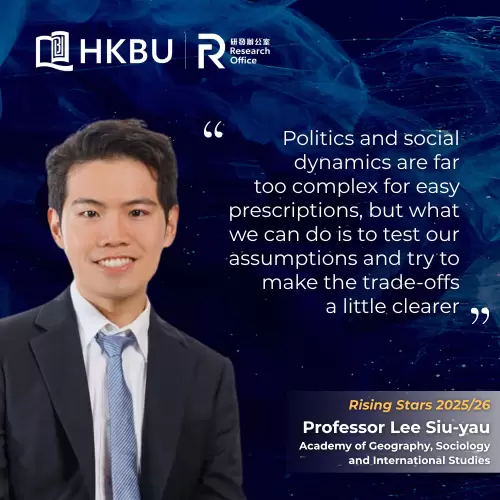
Driven by his intense curiosity about rules, authority, and institutions, Professor Lee Siu-yau (Associate Professor, Academy of Geography, Sociology and International Studies) has gravitated instinctively towards social policy. After completing his bachelor’s degree at The Chinese University of Hong Kong, he earned an MSc in Modern Chinese Studies and a PhD in Politics at the University of Oxford as a Swire Charitable Trust scholar. After exploring the field, Professor Lee eventually focused on immigration, which he believes reaches beyond social mobility to how people understand belonging and social obligations.
Professor Lee’s sustained research excellence has been recognised by the University, and he has been selected as one of only six 2025/26 Rising Stars for his proposed project “(Im)migration Attitudes in a Highly Mobile Society: Policy Feedback and Global Comparisons”.
The Research Office (RO) spoke with Professor Lee about his proposal and ongoing research.
RO: How would you describe your funded project to non-specialists?
Lee: My project asks how the design of immigration policy shapes public opinion.
I shall question some 1,500 adults in Hong Kong about their own migration intentions and their attitudes toward high- and low-skilled immigrants. The survey includes an experiment in which people are shown different policy packages, which will allow us to identify which choices matter most, and the findings will be placed in a wider international context through collaboration with the World Association for Public Opinion Research. Alongside this, I will pilot AI-assisted methods to estimate public opinion, using the Hong Kong survey as a benchmark. This part is exploratory and secondary to the main survey work.
The aim is to show how immigration policy shapes public attitudes, starting from Hong Kong and linking into a wider global conversation. The project will also support major publications and, eventually, a book.
RO: As global competition for talent intensifies, how can policymakers better align their immigration strategies with public values without compromising on inclusivity and equality?
Lee: Politics and social dynamics are far too complex for easy prescriptions, but what we can do is to test our assumptions, and try to make the trade-offs a little clearer.
One thing my research has taught me is that we cannot simply assume that attracting highly skilled talent automatically guarantees community acceptance. Public attitudes are much more conditional than that. People naturally look for commitment, fairness, and reciprocity, and they want to know if newcomers are willing to integrate into the local community in the long run.
This means that policy design carries a lot of weight. The rules we set on residency, work rights, and access to services are not just technical details. They communicate expectations to both the public and the migrants about how they will coexist. And because these dynamics are so complicated, we need faster, more cost-effective ways to gauge community reception before policymakers commit to specific designs.
RO: How has the environment at HKBU allowed you to pursue and deliver high-quality research?
Lee: HKBU is a very supportive place to do research, and awards and recognition like the Rising Star Research Grant are a clear testimony to that. This kind of support matters a great deal to me, not only because experiments and international collaboration are expensive, but also because it recognises diverse ways of developing knowledge and creating an impact.
The University has the resources to attract talented scholars from across the world. Being surrounded by people with different experiences and perspectives is a real source of inspiration. What I value especially is the strong transdisciplinary culture here. We often talk across disciplines, and I feel supported in pursuing work that might not fit neatly within a single field. That kind of support does not happen by accident: it comes from colleagues across the academy and faculties, the Research Office, and university management, all of which are willing to back serious research in different forms.
RO: What unique qualities of your research team keep you inspired and encourage you on this academic journey
Lee: What keeps me inspired is less a formal team structure, and more a certain way of working together. Quite a few of my colleagues here were also my PhD peers at Oxford, so working with them takes me back to those good old days when ideas could begin in a café or over a meal, and gradually develop into serious research questions. That makes the research much more enjoyable.
For example, one of my GRF projects asks when people may be reluctant to assume decision-making authority in the age of AI, an idea that grew out of a discussion with a philosopher in our department. In another project, a colleague helped me gain access to a cross-national dataset that has allowed me to revisit the common view that the threat of disease necessarily weakens public support for immigrants.
RO: When you are not in the lab or classroom, how do you like to unwind?
Lee: Family life is probably my main way of unwinding, although I often find that it comes with its own kind of stress.
With a child, you are constantly seeing familiar things through new eyes. We read, explore, and learn small things together, and I enjoy being both a teacher and a student. It reminds me that curiosity does not have to be formal or professional. Sometimes it begins with a simple question at home.
So I may not completely switch off from learning, but spending time with my family gives it a different rhythm. It helps me step back from the pressure of work and return to it with a clearer mind.
RO: If you could share just one piece of wisdom with the next generation of researchers, what would it be?
Lee: To keep doing work you believe in, and learn to live with a certain amount of frustration. You do not have to enjoy every setback, but you do have to keep going.