

HKBU researchers uncover herbal compound "Icariin" as key to boosting cancer immunotherapy via gut microbiota

A research team led by scientists at Hong Kong Baptist University (HKBU) has made a significant discovery in cancer immunotherapy. The study, titled “Icariin Enhances the Enzymatic Activity of N-acetylgalactosaminidase to Augment Akkermansia Abundance in Gut Microbiota for Improved PD-1 Blockade Efficacy in Tumour Suppression”, was published in the prestigious international journal Advanced Science. It reveals that Icariin, a natural flavonoid derived from the traditional Chinese medicinal herb Epimedium, can significantly enhance the efficacy of PD-1 blockade therapy by modulating the gut microbiome.
The research was co-led by Professor Lyu Aiping, Vice-President (Research and Development) and Chair Professor of the School of Chinese Medicine at HKBU, and Professor Li Fangfei, Associate Professor of the School of Chinese Medicine, as co-corresponding authors. The study was supported by the General Research Fund (GRF) and the Theme-based Research Scheme (TRS) of the Research Grants Council (RGC).
Overcoming Key Bottlenecks in Immunotherapy
While Immune Checkpoint Inhibitors (ICIs), such as anti-PD-1 antibodies, have revolutionised cancer treatment, clinical response rates are heavily influenced by individual patient differences and the gut microbiota. Previous research suggests that the abundance of the bacterium Akkermansia Muciniphila (Akk) plays a crucial role in determining immunotherapy success. However, using Akk directly as a probiotic faces hurdles regarding intestinal colonisation, stability, and safety.
The HKBU team provided a new solution by identifying Icariin as a potent "prebiotic". The study found that oral administration of Icariin selectively increased Akk abundance in both tumour-bearing and non-tumour-bearing mice, regardless of whether the immune system was intact or compromised.
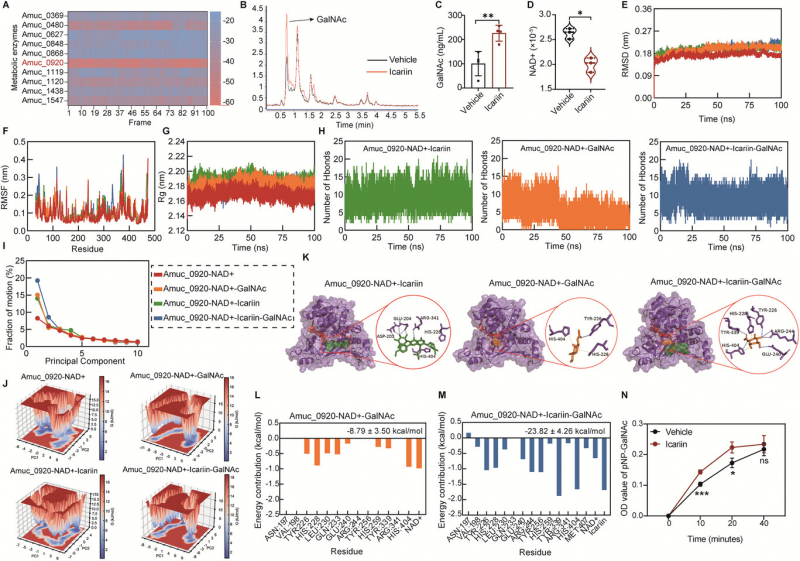
Icariin enhanced the activity of the N-acetylgalactosaminidase Amuc_0920 by stabilizing key residues at the binding sites for the substrate GalNAc.
Mechanism: Precision Enhancement of Enzyme Activity
Using multi-omics technologies including transcriptomics, metabolomics, and single-cell RNA sequencing (scRNA-seq), the team decoded the underlying mechanism. They discovered that Icariin binds to N-acetylgalactosaminidase (Amuc_0920), an enzyme secreted by Akk. By stabilizing key residues at the enzyme's binding site with its substrate, GalNAc, Icariin significantly boosts enzymatic activity. This process strengthens mucin catabolism, providing the "nutrients" necessary for Akk to flourish.
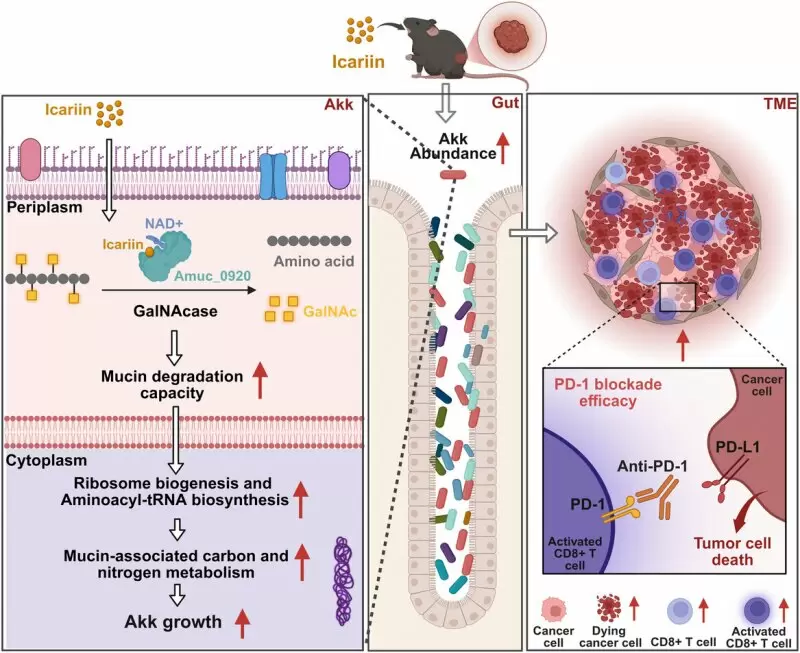
Icariin promoted the growth of Akk by enhancing the activity of N-acetylgalactosaminidase (Amuc_0920), which enhanced mucin utilization and provided a favorable nutrient environment for bacterial growth. This icariin-mediated enrichment of Akk further reshaped the tumor microenvironment and promoted CD8+ T cell infiltration, ultimately synergizing with PD-1 blockade therapy to suppress tumor progression.
Boosting Anti-Tumour Immune Responses
Functional experiments confirmed that Icariin-induced Akk enrichment enhances the function of tumour-infiltrating CD8+ T cells. In mouse models of melanoma (B16) and lung cancer (LLC), the combination of Icariin and anti-PD-1 therapy proved significantly more effective at suppressing tumour growth than monotherapy alone.
Leading the Way in TCM Modernization
This study not only identifies Icariin as a specific prebiotic for Akk but also reveals how Chinese medicine components can reshape the tumour immune microenvironment by regulating the gut microbiota. This paves the way for developing novel "prebiotic-enhanced" combined cancer immunotherapies.
More about Professor Lyu's research profile: Aiping LYU - Hong Kong Baptist University
More about Professor Li's research profile: Fangfei LI - Hong Kong Baptist University