

HKBU scientists solve the puzzle of why some burnt lands become dust storms—and why some don't
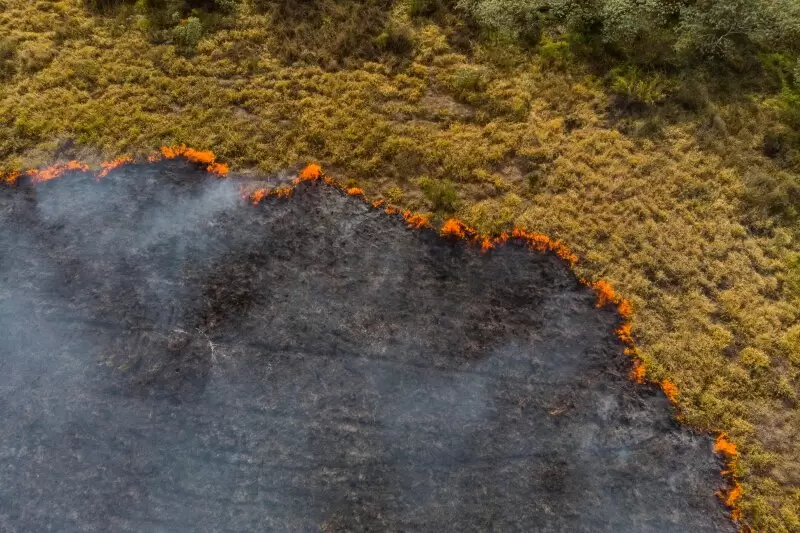
Mineral dust is a major component of atmospheric aerosols with significant influence on climate systems, biogeochemical cycles, and human health. While traditionally associated with natural deserts and human-disturbed lands, a significant new source has been identified: landscapes burnt by wildfires.
Satellite studies indicate dust emissions increase after more than half of all large wildfire events globally, contributing an estimated 100 Tg of dust per year. However, this response varies dramatically across ecosystems, and the underlying mechanisms have remained unclear—creating major uncertainty in global dust cycle projections.
New research by Hong Kong Baptist University (HKBU) scientists, published in Science Bulletin, provides a critical new perspective.
.png)
Led by Professor Gao Meng (left) and Dr Yang Qianqian (right) from the Department of Geography, the study “Heterogeneous global responses of dust to wildfires explained by ecosystems' differing moisture-holding capacity” analysed over two decades of satellite data (2002–2023) and more than 60,000 large-scale wildfires to solve a key puzzle: why do some burnt landscapes become major dust sources while others do not?
The answer lies in a delicate balance between fire-induced vegetation loss, wind speed, and—most importantly—an ecosystem's capacity to retain soil moisture.
Key Findings: An Ecosystem-Dependent Response
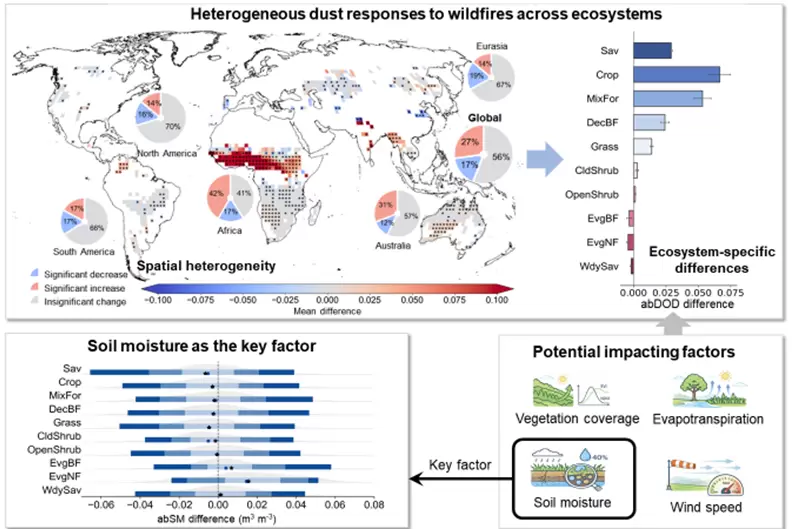
The analysis reveals a clear pattern: post-fire dust activity increases in savannas, croplands, grasslands, shrublands, and deciduous forests, but decreases in evergreen forests.
- Increased Emissions: In most ecosystems, vegetation loss reduces surface roughness. Coupled with decreased soil moisture and increased wind speed, this leads to enhanced wind erosion and dust emission.
- Decreased Emissions: In evergreen forests, rapid post-fire recovery of soil moisture stabilises the soil surface, suppressing dust emissions.
These findings underscore the critical role of vegetation-soil-climate interactions in post-fire dust dynamics. Integrating these ecosystem-specific relationships into Earth system models is essential for improving predictions of dust impacts on climate, air quality, and public health. This work also provides a scientific basis for managing dust-related risks in fire-prone regions worldwide.
Full research: https://www.sciencedirect.com/science/article/pii/S2095927326000459
Previous News

Next News