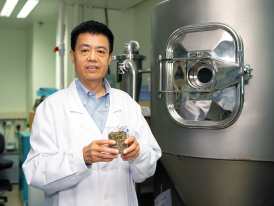


Professor Dai Hongning and research team unveil innovative self-updating meta-learning model for IoT traffic classification

The rapid expansion of the Internet of Things (IoT) has brought an unprecedented surge in network data, much of it heavily protected by advanced security protocols. Traditional methods of managing and securing these networks are hitting a wall, as Professor Dai Hongning (Associate Professor, Department of Computer Science) and collaborating researchers from ABV-IIITM Gwalior in India observe in a 2026 study published in the IEEE Internet of Things Journal: "Traditional port-based and DPI methods are ineffective under encryption and dynamic port usage, motivating ML/DL-based encrypted traffic analysis."
However, even modern deep learning solutions have a critical flaw. They assume the digital world stands still, and the researchers write that "most DL-based approaches assume static traffic distributions and fixed application sets, limiting their robustness under real-world traffic evolution."
The innovation
Professor Dai and his team propose a solution to this vulnerability, in their paper "A Self-Updating Hybrid Meta-Learning Framework for IoT Traffic Classification". Their system addresses the core challenge of network adaptability by continuously monitoring its own certainty, automatically triggering updates when it encounters traffic it does not recognise.
The architecture
At the heart of this framework is a strategic division of labour that balances deep statistical awareness with high-speed decision-making. Rather than using an expensive, fully Bayesian architecture for everything, the framework divides the work into distinct, specialised components, using a proxy Bayesian Neural Network (BNN) tasked strictly with evaluating prediction confidence and identifying when data distributions begin to drift. Alongside this, a collection of traditional, high-speed deterministic models such as a gradient-boosted tree and a multilayer perceptron process raw traffic features rapidly to ensure "heterogeneous inductive biases and low prediction correlation." Finally, a random forest meta-classifier acts as the ultimate decision maker, fusing all of these outputs into a single classification. The researchers write that “the hybrid design enables robustness by combining epistemic uncertainty obtained from Bayesian inference with discriminative feature learning from tree-based models.”
The mechanism
A key innovation of this framework lies in how it flags unknown traffic without dragging down the network's processing speed. It utilises the Hellinger distance to evaluate prediction instability directly from the Bayesian outputs, and the researchers highlight that this method allows for the "normalization-free detection of unfamiliar traffic, with a tunable parameter α controlling instability influence." By avoiding traditional, heavy normalisation steps, the framework keeps its computational footprint incredibly light. When incoming packets produce chaotic or highly erratic predictions, the framework calculates a specialised familiarity score. If the instability crosses a certain boundary and the familiarity score drops too low, the system flags the traffic for inspection. The researchers note " A packet is considered new if it exhibits high instability and low familiarity indicating a deviation from the learned traffic distribution."
The adaptation
Instead of forcing a massive, resource-heavy full retraining session every time a new application alters the network traffic, the system relies on selective data gathering. Unfamiliar, flagged packets are captured, filtered, and buffered into an expanded knowledge base, which "ensures high-quality updates while preventing noise accumulation." From there, the random forest meta-classifier undergoes a rapid, lightweight retraining step to absorb the new information. The researchers explain "This incremental learning mechanism ensures that the hybrid model remains adaptive to evolving encrypted traffic while maintaining computational efficiency and minimizing retraining overhead."
The results
The practical results of this architecture speak for themselves. In rigorous testing using the benchmark ISCX 2016 dataset, which tracks encrypted traffic across activities like browsing, mailing, streaming, and VoIP, the hybrid meta-learner radically outperformed existing state-of-the-art models. The researchers conclude that their "experimental results on encrypted traffic datasets demonstrate significant gains in reliability, achieving up to 95.7% accuracy and 0.95 macro-F1, and effective selective retraining under distribution shifts." By successfully merging interpretability, computational efficiency, and autonomous adaptability, this framework sets a new standard for securing and managing the next generation of dynamic IoT environments.
Full paper: https://ieeexplore.ieee.org/document/11408206

Professor Dai Hongning
Department of Computer Science
Professor Dai’s research profile: https://scholars.hkbu.edu.hk/en/persons/HENRYDAI
Previous News