

Professor Hu Di awarded NSFC/RGC JRS grant to study airborne flame retardants and health risks in Hong Kong and Beijing
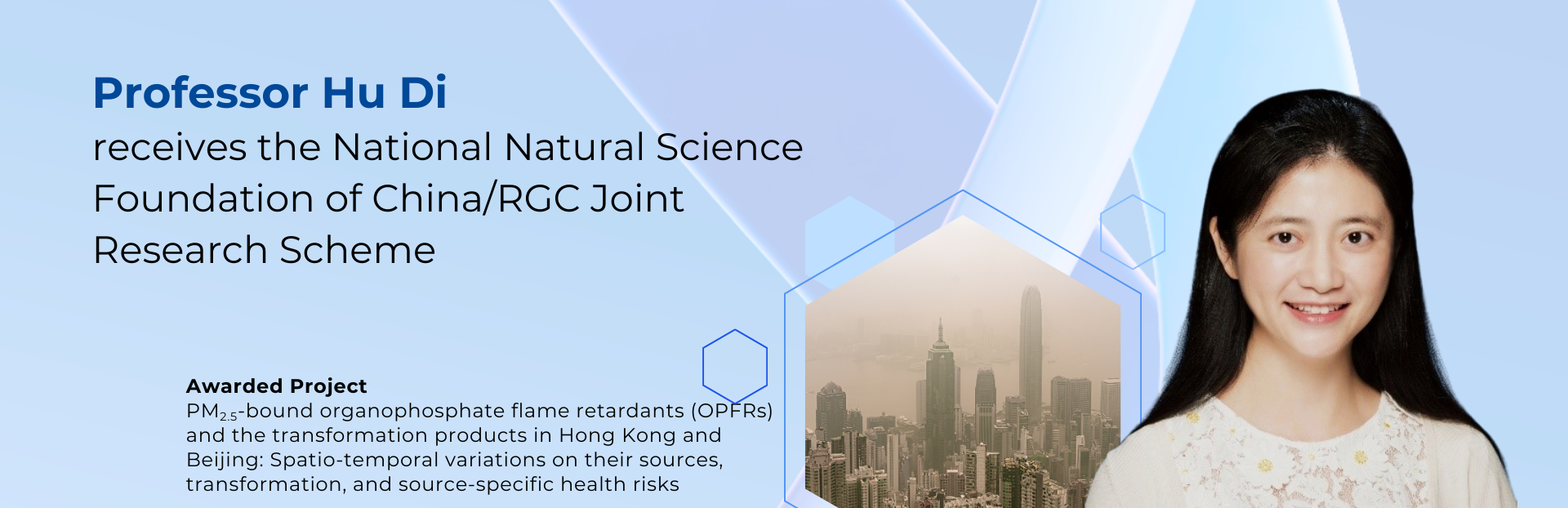
Professor Hu Di of the Department of Chemistry, Faculty of Science has been awarded the grant of HK$1,217,095 under the National Natural Science Foundation of China/Research Grants Council Joint Research Scheme (NSFC/RGC JRS) for 2025/26.
Professor Hu’s project, entitled “PM2.5-bound organophosphate flame retardants (OPFRs) and the transformation products in Hong Kong and Beijing: Spatio-temporal variations on their sources, transformation, and source-specific health risks”, focuses on an emerging group of organic pollutants that are commonly found in atmospheric fine particulate matter (PM2.5) and may pose significant risks to human health.
The team will identify and quantify both traditional and novel OPFRs in PM2.5 and map their spatio-temporal distribution in the two megacities. Laboratory simulation experiments will be conducted to characterise the atmospheric transformation mechanisms and products of OPFRs, particularly the novel compounds of concern. Leveraging advanced chromatography–mass spectrometry techniques, the project will systematically investigate OPFRs and their atmospheric transformation products in Beijing and Hong Kong through a three-year field monitoring campaign.
In addition, the researchers will apply a tracer-integrated source apportionment model to assess quantitatively the contributions of primary emissions and secondary formation processes to OPFRs in the atmosphere. Cell-based toxicological experiments will then be used to examine how atmospheric transformation affects the toxicity of OPFRs, and to evaluate the roles of different sources and processes in driving health risks.
The study is carried out in collaboration with researchers of Peking University, bringing together complementary strengths in environmental and atmospheric chemistry across the Mainland and Hong Kong. By constructing a comprehensive framework that links OPFR sources, atmospheric transformation, exposure, and associated health risks, the project aims to generate scientific evidence that can support regional pollution control strategies and inform policies to better protect public health.
For the research project details, please see:
![[Funded Project Update] Nine HKBU projects awarded grants from GDSTC](/f/news/23073/274p0/News%20-%20Latest%20updates%20on%20funding%20projects%20-%20thumbnail%20%281%29.png)