

Cybermobbing on social media: The role of technology in formation, prevention, and intervention of online collective deviant behavior
Project Description
Cybermobbing on social media is an important but under-researched problem that poses a threat to individuals and societies. Cybermobbing refers to a group of like-minded people gathering online to collectively shame, harass, threaten, or discredit someone outside their group. Because of the unique characteristics of the social media environment, cybermobs can gather quickly around an idea and do something harmful to others.
Cyberbullying is an important research topic across disciplines. With its roots in psychology, education, and public health research, empirical evidence on the social media environment in shaping and preventing cyberbullying remains relatively unexplored. The project team proposed the socio-technical perspective to study the collective nature and mechanism of cybermobbing on social media and evaluate technology-based prevention and intervention strategies. The most impactful area for this project is the identification of technical artefacts that would be integrated into the design of social media platforms to discourage the occurrence of cybermobbing behaviours.
The project team leveraged their expertise in typology research, scenario-based research, fake news detection, and social media analytics to advance our theoretical understanding of this new and important phenomenon on social media platforms. As this is a nascent field internationally, the results from the project will pioneer scientific inquiries in the largely uncharted research territories with far-reaching impacts. In addition, this project will help researchers, platform providers, governments, educators, and parents understand the unique characteristics of cybermobbing in the social media context.
Project Investigator
Professor Christy M K CHEUNG (Department of Management, Marketing and Information Systems)
Funding/Award
- Research Grants Council - Senior Research Fellow Scheme (website)
Publications
- Chan, T. K., Cheung, C. M., Benbasat, I., Xiao, B., & Lee, Z. W. (2023). Bystanders Join In Cyberbullying on Social Networking Sites: The Deindividuation and Moral Disengagement Perspectives. Information Systems Research, 34(3), 828-846. doi.org/10.1287/isre.2022.1161
- Wong, R. Y. M., Cheung, C. M., Xiao, B., & Thatcher, J. B. (2021). Standing Up Or Standing By: Understanding Bystanders’ Proactive Reporting Responses to Social Media Harassment. Information Systems Research. 32(2), 561-581. doi.org/10.1287/isre.2020.0983
- Li, Y. J., Cheung, C. M., Shen, X. L., & Lee, M. K., (2024). Doxing on Social Networking Sites: An Extension of the Social Cognitive Theory of Moral Thought and Action. Journal of the Association for Information Systems. Journal of the Association for Information Systems, 25(6), 1466-1499. DOI: 10.17705/1jais.00898
- Li, Y. J., Cheung, C. M., Shen, X. L., & Lee, M. K., (2022). When Socialization Goes Wrong: Understanding We-Intention to Participate in Collective Trolling in Virtual Communities, Journal of the Association for Information Systems, 23(3), 678-706. doi.org/10.17705/1jais.0073
Media Coverage
Times Higher Education - Campus
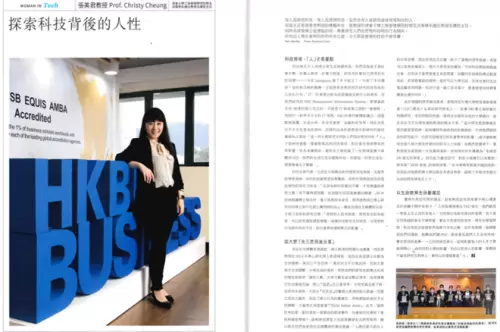
HKBU Business Research Insight