

Exploration of Justicia plants as innovative antimicrobial solutions against highly pathogenic avian influenza virus (HPAIV) for veterinary and human health
Project Description
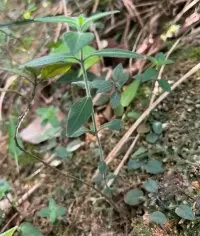
The primary objective of this project is to develop feed additives and veterinary drugs using the broad-spectrum antiviral properties of the Chinese Justicia medicinal plants (Figure 1) and their lignan compounds, with a specific emphasis on avian influenza viruses (AIVs). By targeting the global farming and pet markets, which exceed HK$1,000 billion annually, we aim to significantly reduce the economic losses caused by over 87 viruses that inflict animal health, thereby contributing to Hong Kong and global economies.
The frequent occurrences of AIVs in areas around Hong Kong make the city a critical starting point with a significant global impact. Recently, AIVs have spread to various regions, including the USA, raising serious concerns. Vaccination, the current prevention method, is costly, difficult to implement, and often less effective due to constant viral mutations. AIVs also infect mammals, including dairy cows and humans. Human infections by AIVs like H5N1 can cause severe illness and high mortality rates exceeding 50%. This highlights the serious threat influenza poses to both animal and human health. Additionally, few antiviral drugs are available for animals, typically targeting only a single virus and animal species. Hence, there is an urgent need for effective, safe solutions to combat multiple viruses, including AIV.
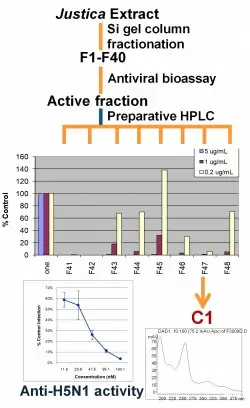
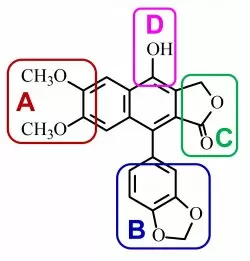
We discovered that the root extracts of Justicia plants displayed potent inhibitory effects against the H5N1 virus, without showing toxicity to host cells (Figure 2). Our structure comparison analysis revealed that the antiviral compounds in Justicia plants are lignans, which have demonstrated antiviral activities against a wide range of viruses, including H5N1 virus, HIV and SARS-CoV-2. Mechanism studies indicated that these compounds target host cell infection by blocking viral fusion. We have since synthesised over 200 analogues and elucidated their structure-activity relationships (Figure 3).
Our approach to developing Justicia compounds involves two stages. The first stage focuses on developing effective antiviral veterinary drugs by advancing Justicia plant cultivation and the production of active components, as well as conducting safety and effectiveness testing in GLP and GCP facilities. This will lead to the formulation of final products that introduce innovative feed additives and veterinary drugs to the animal market, benefiting the farming and pet industries. Building on the results of the veterinary drug efficacy studies, we will further advance the active Justicia constituents for new broad-spectrum human antiviral drugs. These products will have the potential to save billions of farming animals and help prevent and treat emerging viruses that could cause future pandemics.
Project Investigator
Professor ZHANG Hongjie (School of Chinese Medicine)
Project Collaborators
- Dr Abdullah Al MAMUN (School of Chinese Medicine)
- Dr XIE Wenjian (School of Chinese Medicine)
- Dr LAM Chu Shing (School of Chinese Medicine)
- Ms CHAN Wing Num (School of Chinese Medicine)
Dr CHU Hin (University of Hong Kong)
Professor RONG Lijun (University of Illinois Chicago)
Professor. LI Yiping (Sun Yat-sen University)
Professor HU Yingjie (Guangzhou University of Chinese Medicine)
Professor ZENG Jianguo (Hunan Agricultural University)
Funding/Award
- Innovation and Technology Commission - Innovation and Technology Fund (Mainland-Hong Kong Joint Funding Scheme)
- Research Grants Council - General Research Fund
Patents
- Zhang, Hongjie; Li, Wanfei; Tsang, Nga Yi. Patentiflorin A analogs as antiviral agents. PCT/CN2020/111463: granted in the US on May 2, 2023 (US11,638,713B2). (Application in: US, European, China); [Granted in: US (2023)].
- Zhang, Hongjie; Zhu, Yu; Tsang, Nga Yi; Zhao, Yang. Tuberculatin analogs as antiviral agents. PCT/CN2021/136032: filed on December 7, 2021. (Application in: US, China).
- Zhang, Hongjie; Rong, Lijun; Soejarto, D. Doel; Fong, Harry H. S.; Rumschlag-Booms, Emily. Aryl naphthalide lignans as anti-HIV agents. PCT/US2012/048657: granted in China on February 15, 2017 (ZL2012 8 0048097.2); granted in European on June 22, 2016 (EP2736903 B1); granted in Hong Kong on January 5, 2018 (HK1196608). (Application in: US, China, Eu-Germany, Eu-UK, HK); [Granted in: China (2017), HK (2018), European (2016)].
Publications
- Hu, Mingyue; Li, Wanfei; Wu, Tiantian; Yang, Yang; Chen, Guoquan; Chen, Tongling; Liu, Yongchen; Mei, Yaqing; Wu, De; Wei, Youchuan; Luo, Tingrong; Zhang, Hongjie;* Li, Yiping.* Identification of an arylnaphthalene lignan derivative as an inhibitor against dengue virus serotypes 1 to 4 (DENV-1 to -4) using a newly developed DENV-3 infectious clone and replicon. Microbiology Spectrum 2023, 11 (4), e00423-23. doi: 10.1128/spectrum.00423-23
- Xu, Xinya; Wong, Dongying; Li, Yiping; Deyrup, Stephen T;* Zhang, Hongjie.* Plant-derived lignans as potential antiviral agents: a systematic review. Phytochemistry Reviews 2022, 21 (1), 239-289. doi: 10.1007/s11101-021-09758-0
- Zhao, Yang; Ku, Chuen-Fai; Xu, Xinya; Tsang, Nga-Yi; Yu Zhu, Yu; Zhao, Chenliang; Liu, Kanglun; Li, Chuangchuang; Rong, Lijun; Zhang, Hongjie.* Stable axially chiral isomers of arylnaphthalene lignan glycosides with antiviral potential discovered from Justicia procumbens. The Journal of Organic Chemistry 2021, 86 (8), 5568-5583. doi: 10.1021/acs.joc.1c00068
- Xu, Xinya; Wang, Dongying; Ku, Chuenfai;# Zhao, Yang; Cheng, Han; Liu, Kanglun; Rong, Lijun;* Zhang, Hongjie.* Anti-HIV lignans from Justicia procumbens. Chinese Journal of Natural Medicines 2019, 17 (12), 945-952. doi: 10.1016/S1875-5364(19)30117-7
- Martinez-Lopez, Alicia; Persaud, Mirjana; Chavez, Maritza Puray; Zhang, Hongjie; Rong, Lijun; Liu, Shufeng; Wang, Tony T.; Sarafianos, Stefan G.; Diaz-Grifferoa, Felipe.* Glycosylated diphyllin as a broad-spectrum antiviral agent against Zika virus. EBioMedicine 2019, 47 (September), 269-283. doi: 10.1016/j.ebiom.2019.08.060
- Zhang, Hongjie;* Rumschlag-Booms, Emily; Guan, Yifu; Wang, Dongying; Liu, Kanglun; Li, Wanfei; Nguyen, Van H.; Nguyen M.; Soejarto, Djaja D.; Fong, Harry H. S.; Rong, Lijun.* Potent inhibitor to drug-resistant HIV-1 strains identified from the medicinal plant Justicia gendarussa. Journal of Natural Products 2017, 80 (6), 1798-1807. doi: 10.1021/acs.jnatprod.7b00004
- Zhang, Hongjie;* Rumschlag-Booms, Emily; Guan, Yifu; Wang, Dongying; Liu, Kanglun; Li, Wanfei; Nguyen, Van H.; Nguyen M.; Soejarto, Djaja D.; Fong, Harry H. S.; Rong, Lijun.* Anti-HIV diphyllin glycosides from Justicia gendarussa. Phytochemistry 2017, 136 (April), 94-100. doi: 10.1016/j.phytochem.2017.01.005
- Tsang, Nga Yi; Zhao, Lihan; Tsang, Siu Wai; Zhang, Hongjie.* Antiviral activity and molecular targets of plant natural products against avian influenza virus. Current Organic Chemistry 2017, 21 (18), 1777-1804. doi: 10.2174/1385272821666170227120138