

From target understandings of sclerostin to therapeutic aptamer drug discovery
Project Description
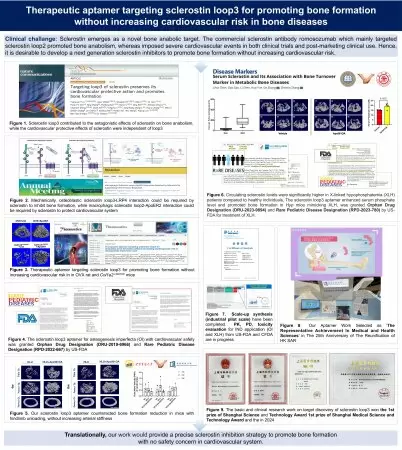
Extracellular sclerostin emerges as a novel bone anabolic target. The commercial sclerostin antibody Romosozumab which mainly targeted sclerostin loop2 promoted bone anabolism, whereas imposed severe cardiovascular events in clinical use. We previously found that sclerostin loop3 contributed to the antagonistic effects of sclerostin on bone anabolism, while the cardiovascular protective effects of sclerostin were independent of loop3.
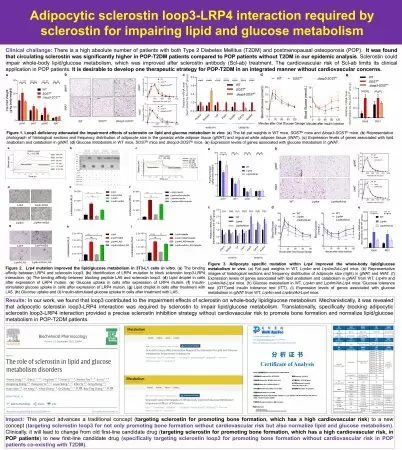
Mechanically, osteoblastic sclerostin loop3-LRP4 interaction was required by sclerostin to inhibit bone formation, while macrophagic sclerostin loop2-ApoER2 interaction was required by sclerostin to protect the cardiovascular system. Accordingly, one therapeutic aptamer targeting sclerostin loop3 was developed in our lab. Targeting sclerostin loop3 by the developed aptamer was determined to promote bone anabolism in OVX rats with postmenopausal osteoporosis, Col1a2+/G610C mice mimicking osteogenesis imperfecta (OI), Hyp mice mimicking X-linked hypophosphatemia (XLH), as well as hindlimb-unloaded mice with disuse osteoporosis, without increasing the cardiovascular risk. This aptamer with cardiovascular safety was granted Orphan Drug Designation (DRU-2022-9087, DRU-2023-9894) and Rare Paediatric Disease Designation (RPD-2022-667, RPD-2023-780) by the US-FDA for the treatment of both OI and XLH. The above work won the 1st prize of Shanghai Medical Science and Technology Award (20234025-1-R02) and the 1st prize of Shanghai Science and Technology Award (2023010602) in 2023. Moreover, sclerostin participated in impairing lipid/glucose metabolism. Sclerostin inhibition could improve lipid/glucose metabolism. However, the cardiovascular risk limits the application of the sclerostin antibody Romosozumab.
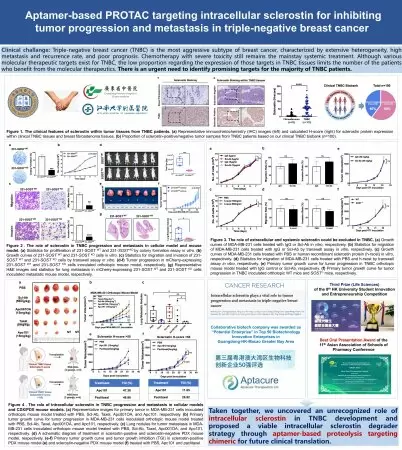
We first revealed that sclerostin loop3 participated in impairing lipid/glucose metabolism. Specifically blocking sclerostin loop3-LRP4 interaction, but preserving macrophagic sclerostin loop2-ApoER2 interaction would be a precise sclerostin inhibition strategy to promote bone anabolism and normalise lipid/glucose metabolism, without increasing cardiovascular risk. For intracellular sclerostin, we found that sclerostin expressed in the majority of clinical TNBC tissues, which was associated with tumour progression and poor prognosis. In TNBC xenograft and syngeneic models, sclerostin knockout markedly impeded tumour progression/metastasis. Neither recombinant sclerostin protein nor sclerostin antibody had any effects in TNBC cells and mouse models, suggesting that the role of extracellular and systemic sclerostin could be excluded. Our genetic and pharmacologic evidence (aptamer-based PROTAC, Apc101) both suggested the vital role of intracellular sclerostin in TNBC. To translate the new molecular understanding into drug discovery, dosing with Apc101 induced significant tumour regression in the TNBC cell line-derived xenografts (CDX) model and sclerostin-positive TNBC patient-derived xenografts (PDX) model. It uncovered an unrecognised role of intracellular sclerostin in TNBC and proposed a viable intracellular sclerostin degrader strategy through aptamer-based PROTAC for future clinical translation.
Project Investigator
Professor LYU Aiping (School of Chinese Medicine)
Project Collaborators
- Professor ZHANG Ge (School of Chinese Medicine)
- Dr WANG Luyao (School of Chinese Medicine)
- Dr SUN Meiheng (School of Chinese Medicine)
- The Shanghai Tenth People's Hospital, Tongji University, China
- Guangxi Normal University, China
- Air Force Medical University, China
- Shanghai Sixth People's Hospital Affiliated to Shanghai Jiao Tong University School of Medicine, China
- Guangdong Provincial Hospital of Chinese Medicine, China
- Affiliated Hospital of Jiangnan University, China
- Shanghai Institute of Technical Physics, Chinese Academy of Sciences, China
- Peking Union Medical College, China
- The University of Sydney, Australia
- Imperial College London, the UK
Funding/Award
- Shanghai Medical Association - 1st prize of Shanghai Medical Science and Technology Award (20234025-1-R02)
- Shanghai Medical Association - 1st prize of Shanghai Science and Technology Award (2023010602)
- Sino-inno Research - Potential Enterprise Award in 2020 Top 50 of Innovative Biotechnology Enterprises in Guangdong-Hong Kong-Macau Greater Bay Area
- Asian Association of Schools of Pharmacy Conference - Best oral presentation award at the 11th Asian Association of Schools of Pharmacy Conference
Publications
- Yu Y, Wang L, Ni S, Li D, Liu J, Chu HY, Zhang N, Sun M, Li N, Ren Q, Zhuo Z, Zhong C, Xie D, Li Y, Zhang ZK, Zhang H, Li M, Zhang Z, Chen L, Pan X, Xia W, Zhang S, Lu A, Zhang BT, Zhang G. Targeting loop3 of sclerostin preserves its cardiovascular protective action and promotes bone formation. Nat Commun. 2022 Jul 22;13(1):4241. https://pubmed.ncbi.nlm.nih.gov/35869074/
- Wang L, Yu Y, Ni S, Li D, Liu J, Xie D, Chu HY, Ren Q, Zhong C, Zhang N, Li N, Sun M, Zhang ZK, Zhuo Z, Zhang H, Zhang S, Li M, Xia W, Zhang Z, Chen L, Shang P, Pan X, Lu A, Zhang BT, Zhang G. Therapeutic aptamer targeting sclerostin loop3 for promoting bone formation without increasing cardiovascular risk in osteogenesis imperfecta mice. Theranostics. 2022 Jul 18;12(13):5645-5674. https://pubmed.ncbi.nlm.nih.gov/35966595/
- Sun, M., Qiao, S., Luo, H., Yang, X., Yang, L., Zhang, H., Chen, Z., Wang, L., Tao, X., Yu, Y., Ma, Y., Yuan, F., Ma, D., Chen, Q., Lu, A., Zhang, B. T., Zhang, G., & Li, F. (2024). Intracellular sclerostin plays a vital role in tumor progression and metastasis in triple-negative breast cancer. Cancer Research, 84(3, Supplement 1), Article B044. https://doi.org/10.1158/1538-7445.ADVBC23-B044.
- Jiang H, Li D, Han Y, Li N, Tao X, Liu J, Zhang Z, Yu Y, Wang L, Yu S, Zhang N, Xiao H, Yang X, Zhang Y, Zhang G, Zhang B-T. The Role of Sclerostin in Lipid and Glucose Metabolism Disorders. Biochem Pharmacol. 2023; 215: 115694. https://www.sciencedirect.com/science/article/abs/pii/S000629522300285X.
- Jiang H, Li D, Wang L, Zhang N, Yu S, Zhang H, Liu J, Ma D, Lu A, Sheng H, Zhang B-T, Zhang G. Sclerostin loop3-LRP4 Interaction Required by Sclerostin for Lipid and Glucose Metabolism Impairment in Adipocyte. Metab: Clin Exp, 2023, 142. https://www.metabolismjournal.com/article/S0026-0495(23)00035-5/abstract.
- Li D, Jiang H, Wang L, Zhang N, Yu S, Zhang H, Li N, Liu J, Lu A, Sheng H, Zhang B-T, Zhang G. Sclerostin Loop3 Participates in Whole-body Lipid and Glucose Metabolism Impairment Effects of Sclerostin. Metab: Clin Exp, 2023, 142. https://www.metabolismjournal.com/article/S0026-0495(23)00042-2/abstract.