

New regulatory mechanism of satiety and therapeutic target for obesity
Project Description

Being overweight or obese significantly increases the risk of life-threatening diseases such as cardiovascular diseases, diabetes, and cancer. According to the 2014/15 Population Health Survey by the Department of Health, about 30% of people in Hong Kong aged 15 to 84 were obese, and another 20% were overweight. The most effective way to tackle obesity is by reducing food consumption, but many obese individuals struggle with regulating their dietary habits due to a diminished sense of satiety. Identifying factors that specifically control body weight and understanding how they regulate satiety is crucial for developing therapeutic approaches for obesity. Our research team identified a proteolytic enzyme called MT1-MMP which regulates the mechanism of issuing satiety signals in the human brain.
Growth and differentiation factor 15 (GDF15) is a hormone that sends out satiety signals by binding with the neuron receptor in the hindbrain called GDNF-family receptor α-like (GFRAL). Mediation of GFRAL can therefore affect the ability of GDF15 to send satiety signals, and thus help regulate food intake. From this starting point, the research team identified the mediation effects of MT1-MMP on GFRAL.
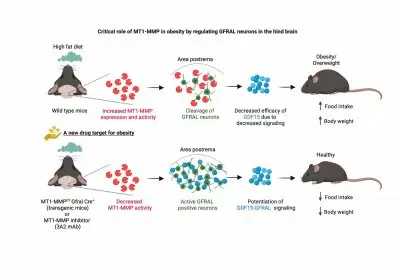
To understand the mechanism by which MT1-MMP suppresses GDF15 satiety signalling, the research team conducted a series of molecular biology experiments involving animal models and cell cultures. The results show that in cells with active MT1-MMP, a significant reduction of GFRAL and thus GDF15 signalling was observed. It could be explained by MT1-MMP clipping GFRAL from the surface of the brain neurons, which blocks GDF15 from binding to GFRAL and thus reduces the number of satiety signals. This in turn keeps the neurons from transmitting the satiety signals sent by GDF15.
The researchers also explored the therapeutic potential of targeting MT1-MMP for obesity management, in particular through pharmacological inhibition of its activity in vivo. With the application of a specific neutralising antibody that inhibits MT1-MMP, significant improvements in metabolic parameters including food intake, glucose tolerance and body weight in obese mice were observed. The results suggest that MT1-MMP is a potential therapeutic target that could be used in the development of innovative drug treatments for obesity.
This significant finding highlights the potential of targeting MT1-MMP as a therapeutic strategy for obesity. Inhibiting this enzyme may help regulate appetite and control body weight, offering a promising new approach to treating obesity and related health issues. Our research team plans to validate these findings in a monkey model, bringing us closer to developing effective obesity treatments for humans. This discovery offers new hope for millions struggling with obesity and its associated health risks, paving the way for innovative therapies that could transform lives.
Project Investigator
Professor WONG Hoi Leong, Xavier (School of Chinese Medicine)
Project Collaborators
- Professor BIAN Zhaoxiang (School of Chinese Medicine)
- University of Helsinki, Finland
- The Chinese University of Hong Kong
Funding/Award
Health Bureau - Health and Medical Research Fund
Publication
Chow CFW, Guo X, Asthana P, Zhang S, Fallah S, Che S, Wang Z, Ge X, Jiang Z, Zhai L, Lin CY, Kwan HY, Huang T, Lyu A, Zhou Z, Bian Z, Wong HLX# (2022) Body weight regulation via MT1-MMP-mediated cleavage of GFRAL. Nature Metabolism 4, 203-212 https://www.nature.com/articles/s42255-022-00529-5
- Highlights of the Issue in Nature Metabolism - [Central regulation of the anorexigenic receptor GFRAL]
- Research Highlights of Nature Reviews Endocrinology- [Negative regulator of GDF15 signaling identified]
- Editor’s choice of Science Signaling - [Cutting down in size by not making a cut]