

New cell entry mechanism of SARS-CoV-2 and therapeutic target for COVID-19
Project Description
Vaccination can protect against COVID-19 and its complications, but it may be less effective for individuals with weak immune systems and against certain variants. Thus, developing more effective treatments remains a significant challenge in the post-vaccine era. Understanding the cell entry mechanism of SARS-CoV-2 is crucial for controlling its spread and discovering new treatments. We found that matrix metalloproteinase (MT1-MMP), an enzyme involved in various physiological processes, significantly impacts the infectivity of SARS-CoV-2.
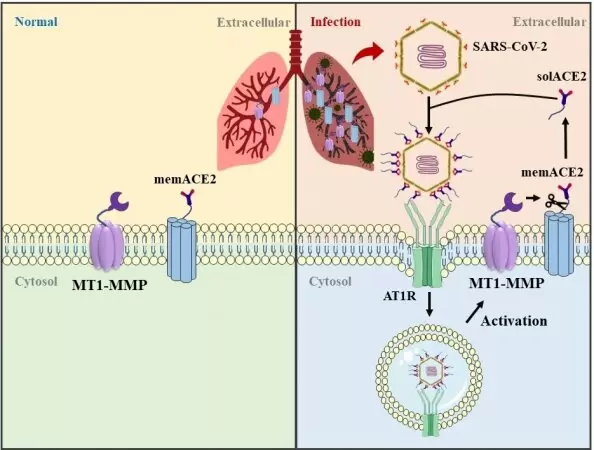
SARS-CoV-2 uses the angiotensin-converting enzyme 2 (ACE2) protein on human cell membranes for entry. Although the lungs are the primary organ affected, only a small proportion of lung cells express ACE2. Previous studies have shown that a soluble form of ACE2 enables the virus to infect organs with low ACE2 levels. This soluble ACE2 binds to SARS-CoV-2, transporting the virus to cells with low ACE2 expression and facilitating its entry.
The team discovered that SARS-CoV-2 infection increases the activation of MT1-MMP, which mediates the release of soluble ACE2 from ACE2-expressing cells. This soluble ACE2 binds to the virus’s spike proteins and carries it to uninfected cells with low ACE2 levels, enhancing infectivity and leading to multi-organ infections. To further study the pathological role of MT1-MMP, researchers used human cells to create organoids, 3D tissue structures grown in vitro to model different organs. They found that blocking MT1-MMP with the monoclonal antibody 3A2 effectively reduced soluble ACE2 levels and decreased SARS-CoV-2 infection in human organoids and mouse models.
Developing COVID-19 drugs faces two major challenges: improving treatment for patients with weakened systems and ensuring effectiveness across different viral strains. 3A2 shows great potential by targeting MT1-MMP, rather than boosting the patient’s immunity or acting directly on the virus. Our studies indicate that 3A2 also protects against obesity and diabetes, major risk factors for severe COVID-19. This makes it particularly suitable for high-risk groups, such as older adults and people with metabolic disorders. Additionally, it could be effective against future coronaviruses with similar entry mechanisms. Although further research is needed before 3A2 can be used in humans, this discovery is a significant step forward in combating COVID-19 and its complications.


Project Investigator
Professor WONG Hoi Leong, Xavier (School of Chinese Medicine)
Project Collaborators
- University of Hong Kong
- The Chinese University of Hong Kong
Publication
Guo X, Cao J, Wu J, Huang J, Asthana P, Wong SKK, Gurung S, Zhang Y, Wang S, Kwan HY, Lyu A, Chan KM, Huang JD, Zhou Z, Bian ZX, Yuan S, Wong HLX# (2022) “Control of SARS-CoV-2 infection by MT1-MMP-mediated shedding of ACE2” Nature Communications, 13, 7907 https://www.nature.com/articles/s41467-022-35590-x