

New regulatory mechanism for insulin resistance and therapeutic target for age-related diabetes
Project Description

Type 2 diabetes (T2D) is a chronic metabolic disorder affecting 370 million adults globally. In healthy individuals, the pancreas secretes insulin to control blood sugar levels after eating. In T2D patients, insulin-sensitive tissues like the liver and muscles do not respond to insulin, a condition known as insulin resistance. This results in prolonged high blood sugar, leading to complications such as limb loss, blindness, and death. The prevalence of T2D and insulin resistance increases with age, but the underlying mechanisms are unclear. The research team identified a crucial enzyme, membrane-type one matrix metalloproteinase (MT1-MMP), that regulates how ageing leads to insulin resistance in humans and monkeys.
Insulin signals cells to remove sugar from the blood by binding with the Insulin Receptor (IR). Therefore, controlling the level of IR can affect insulin’s ability to regulate blood sugar levels and help modulate glucose homeostasis. The research team found that ageing process drives the activation of MT1-MMP systemically. Peripheral MT1-MMP directly sheds insulin receptors from the cell surface, blocking insulin from binding to these receptors and thus reducing insulin signalling.
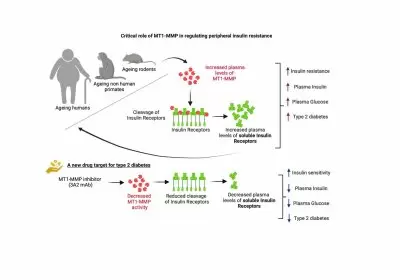
The team also explored the therapeutic potential of targeting MT1-MMP for diabetes management, and found that pharmacological inhibition of MT1-MMP activities by a specific neutralising antibody resulted in significant improvement in metabolic parameters including glucose tolerance and insulin sensitivity in various diabetic mouse models. These results suggest that MT1-MMP is a potential therapeutic target for diabetes.
Previous studies by the team demonstrated that inhibiting MT1-MMP could reduce weight gain in obesity, a significant risk factor for diabetes. This suggests that targeting MT1-MMP could help manage both T2S and obesity, which often require combined treatment strategies. This research highlights MT1-MMP as a critical factor in developing insulin resistance and opens new possibilities for treating T2D and obesity. By targeting this enzyme, future therapies could better manage these chronic conditions, improving the health and quality of life for millions worldwide.
Project Investigator
Professor WONG Hoi Leong, Xavier (School of Chinese Medicine)
Project Collaborators
- Professor BIAN Zhaoxiang (School of Chinese Medicine)
- University of Hong Kong
- University of Texas Health Science Center, Houston, the US
Funding/Award
- National Natural Science Foundation of China - Excellent Young Scientists Fund (Hong Kong and Macau)
- Research Grants Council - General Research Fund
Publication
Guo X, Cao J, Wu J, Huang J, Asthana P, Wong SKK, Gurung S, Zhang Y, Wang S, Kwan HY, Lyu A, Chan KM, Huang JD, Zhou Z, Bian ZX, Yuan S, Wong HLX# (2022) “Control of SARS-CoV-2 infection by MT1-MMP-mediated shedding of ACE2” Nature Communications, 13, 7907 https://www.nature.com/articles/s41467-022-31563-2