

Future Cinema Systems
Project Description
Future Cinema Systems (FCS) is a research project in HKBU’s Creative Media/Practice research cluster led by Professor Jeffrey Shaw that has been awarded HKD 35.4 million by the Hong Kong Innovation and Technology Commission (ITF). In this project Hong Kong Baptist University partners with EPFL Lausanne, Switzerland (led by Prof. Sarah Kenderdine) and City University of Hong Kong (led by Prof. Richard Allen).
FCS aims to expand the cinema’s traditional areas of public engagement by bringing a new range of content under its umbrella, including virtual museums, intangible and tangible cultural heritage, big data archives and multimedia performance. The research harnesses the technological shift towards an increasingly pervasive and sophisticated engagement of the wider multi-sensory palette, whose innovations will answer the persistent and relentless desire for ever more immersive and perceptually convincing media technology. It is not restricted to the visual but encompasses all the human senses. At the heart of this development is the narrative potential of a hybrid, multi-modal space of co-evolutionary interaction between human and machine agents, whereby human intentionality will enter into a dialogue with empathetic AI. This innovative undertaking brings cinema into the 21st century, afforded by fully immersive display technologies and the prodigious real-time imaging capabilities of digital cinema, amalgamated with versatile sensing systems and the algorithmic extension of HCI.
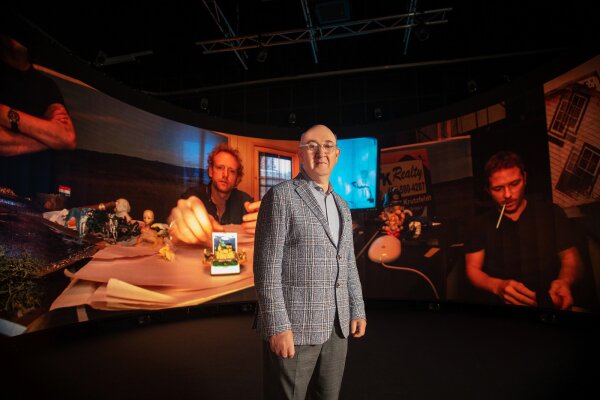
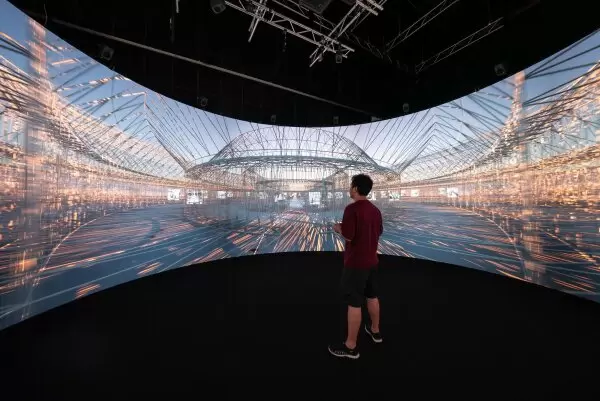
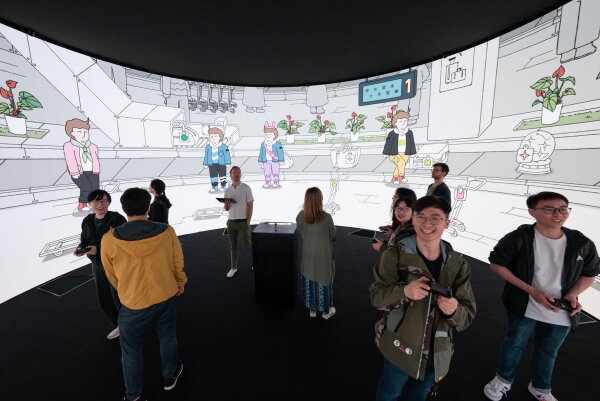
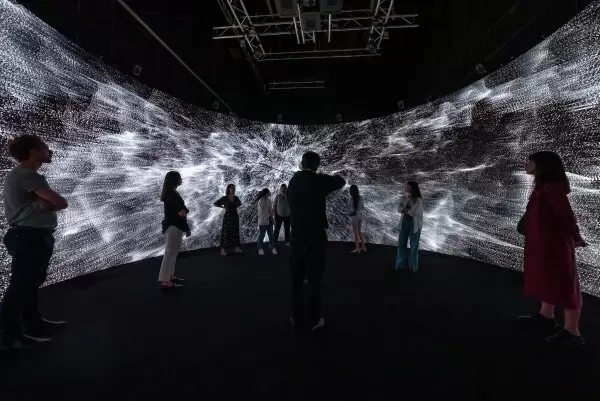
The FCS project will develop three integrated technical platforms for the staging of interactive and immersive audiovisual experiences. The first of these platforms, the Visualisation Engine, will be newly built as the world’s first 360-degree panoramic stereoscopic LED screen. It provides the principal setting for developing, testing and demonstrating co-evolutionary interactivity in a convincing audiovisual mixed-reality setting.
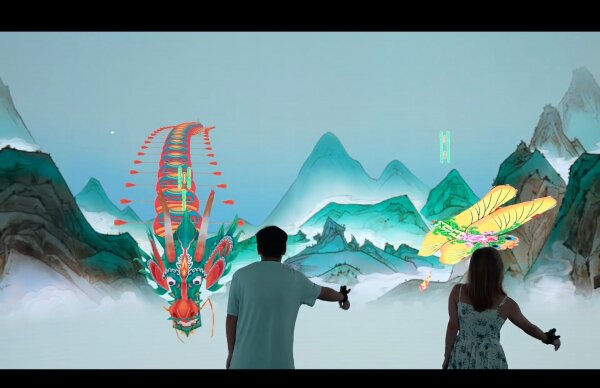
These immersive visualisation environments combine with a second technical ensemble, the Human-Computer Interaction Engine. This consists of an integrated array of sensing inputs including a haptic interface, eye tracking, voice recognition and motion tracking, which will afford the communication of audience behaviour and intentionality towards the audio-visual manifold. The circuit of interactive and immersive experience is completed by a third apparatus, the Co-Evolutionary Narrative Engine. This comprises the software applications that will enable the audiovisual manifold to react and respond to the active and passive sensory prompts provided by participants. It provides a natural and continuous mixed reality interface between the real world and the virtual world.
Combining these three technical platforms FCS undertakes innovative research into the interactive sensory, interpretive, and performative functions of virtual agents capable of responding spontaneously to the complexities of human experience in real-time. These techniques of coevolutionary relationships between virtual agents and human participants in digital environments will enable FCS to construct demonstrators in three areas of applied research: archive, cultural heritage and performance. The benefits of FCS research lie in its capacity to satisfy the rapidly emerging appetite of the digital information society for the aesthetic, moral and emotional enrichment of digital interaction, which is the acknowledged driver of innovation in digital technology. Achievement of the outcomes involves the development of novel forms of interface, an intelligent and responsive audiovisual manifold, and scalable interactive applications.
Website: https://vrc.hkbu.edu.hk/researches/future-cinema-system/

Project Investigator
Professor Jeffrey SHAW (Academy of Visual Arts)
Project Coordinators
- Professor LIU Jiming (Department of Computer Science)
- Professor Peter NELSON (Academy of Visual Arts)
- Professor Roberto ALONSO TRILLO (Academy of Music)
- EPFL Lausanne, Switzerland
- City University of Hong Kong
Funding/Award
Innovation and Technology Commission - Innovation and Technology Fund
_1735890602.png)