

In minor keys: How art, technology, and the everyday inspire knowledge in Kingsley Ng’s practice-led research
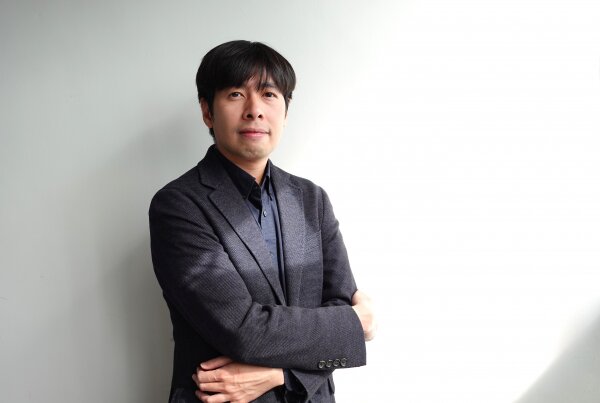
For Associate Professor Kingsley Ng at the Academy of Visual Arts, art can be practice-led research about attention—specifically, how people can be re‑sensitised to rediscover the overlooked in urban life. As Ng prepares for the Hong Kong exhibition at the Venice Biennale, his inquiry, grounded in the subtle, the sensorial, and the everyday, is poised to meet a global audience.
The 2026 edition of the Biennale takes its cue from Chief Curator Koyo Kouoh’s theme, “In Minor Keys.” Echoing this overarching frame, the Hong Kong exhibition, curated by the Hong Kong Museum of Art, is titled “Fermata”, borrowing a concept from music for a moment of reflective pause. Ng resonates deeply with the curatorial intent for “listening to, rather than speaking for… an exhibition experience that is more sensory than didactic, renewing rather than exhausting…”[1] This idea—creating space for a certain state of mind to tune in to the quieter significances—has long shaped his approach to research and practice.
Creating micro‑sanctuaries in the city
At the heart of Ng’s artistic research is a question: how can art offer what he calls “a more contemplative attentiveness to the everyday”? This inquiry is the foundation for his series of immersive installations designed to carve out “micro-sanctuaries” within urban environments.
He reflects on his 2025 project Lullabies, created for public audiences at the East Kowloon Cultural Centre. As the work sought to create a “micro-sancturary” for urban well‑being, it reflected on the notion of rest. But instead of making statements and “speaking for”, together with a cross-disciplinary team, Ng created an ambience with light and sound for hectic urban dwellers to slow down, so they can drift into a mode of “listening to”. In a space where time seemed to be slowed down with sensory prompts, the audience could literally “sleep on” thoughts about rest crowdsourced by the communities (gathered and laid out on actual pillows by collaborating social practitioner Stephanie Cheung) and hear true stories of lullabies from different generations. At the same time, the experience invited the audience to listen to their own needs and pen their own ideas on printed pillows. As a result, the work, collecting over 3,000 feedback, became a capsule for vernacular reflections on rest as a much-needed, but often deprived, necessity in our overworked city.
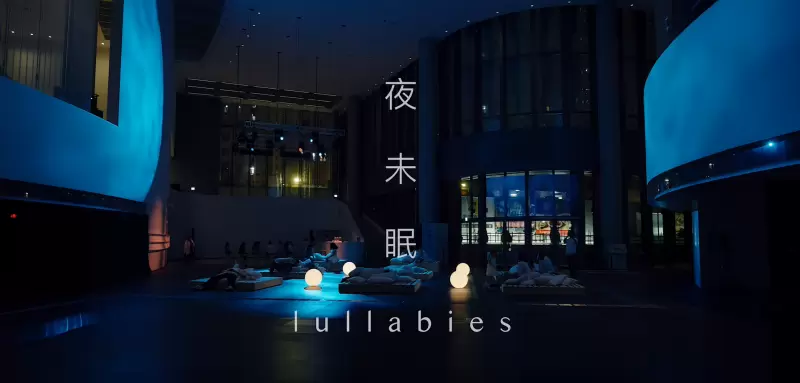
Image Courtesy: Kingsley Ng, Videotage, EKCC
In parallel to an artistic approach to ethnographic research, another inquiry is about the form of space that can be carved out in urban space to foster contemplative attentiveness. Traditionally, sanctuaries were holy sites where people gained spiritual wisdom beyond the mundane. “Can contemporary art serve a similar function–not only for a trained cultural elite, but for wider audiences?” In Lullabies, as in many other projects, everyday materials and references are pathways opening a possibly profound contemplative space to anyone sharing similar human experiences.
This will also be his approach at the upcoming exhibition at the Venice Biennale. While community engagement is difficult for a distant locality, Ng tries to build the same connection with a choice of familiar references. Ng recalls the sight of laundry airing between buildings. “Citizens display their clothing just like an artwork… the colours lined up, arranged, ordered. It’s like a collage of quotidian lives, put together by the citizens as public art in the city.” This will be the point of departure for his next micro-sanctuary, where light is cast on the rhythm of everyday life as the Biennale is envisioned as a space for “listening to”.
Arts and technology for rekindling sensitivity
When we deal with art and technology, there’s a whole spectrum of possibilities. It’s important to revisit technologies—not only the forefront ones.
Professor Kingsley Ng
Academy of Visual Arts
Ng sees the contemporary sensorial overload as a context for these contemplative sanctuaries. In scholarship in urban media art, how the use of technology can transcend stereotypically screen-based spectacles is a critical question. For Ng, who directs the university’s BASc programme in Arts and Technology, the challenge is to heighten, instead of further bombard, perception so that people can rekindle their sensitivity.
While many contemporary artists focus on the latest technological breakthroughs— AI, VR, or real‑time data— Ng takes a more expansive view. He argues that technology should not be defined by novelty alone.
The emphasis for him, as noted, is rather to refresh the senses so people can find amazement as if “seeing light for the first time.
His camera obscura-tram project, Twenty-Five Minutes Older (2015, 2017 and 2018), applying a centuries‑old observation on an optical phenomenon to capture Hong Kong’s urban landscape in a real-time, inverted projection, is one such example. Similarly, in the upcoming exhibition in Venice, with the support of lighting designer Lee Chi-wai, technical designer Jason Wong and engineer Zhang Zilin, he will tap into the magic of physics to spark imaginative amazement and contemplation on the elements, the universe and transience.
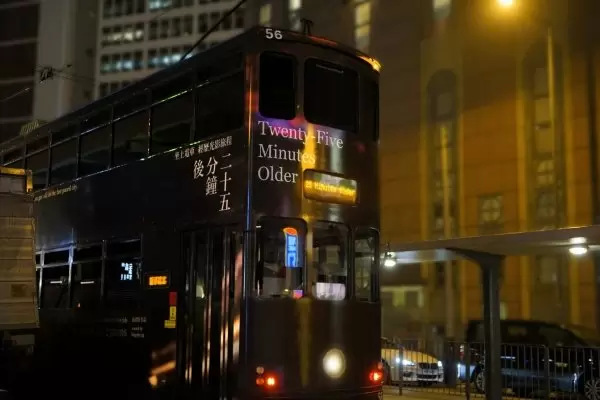
Image Courtesy: Kingsley Ng, HKADC, Art Basel Hong Kong
“Every medium has its own specificities,” he explains. “Every project deserves a revisiting of all the technologies at our disposal to make the best combination for whatever artistic vision we set up.” This philosophy positions his art at the intersection of sensory studies and technological inquiry in a trajectory of arts and technology with millenium-old historical roots.
Transdisciplinarity and collaboration
Collaborating with multi-disciplinary talents and synthesising knowledge into transdisciplinary creations have long been Ng’s modus operandi. For the Hong Kong exhibition in Venice, further to working closely with his multi-disciplinary team, he will also collaborate with fellow selected artist, Angel Hui, a HKBU alumna and lecturer at the HKBU Academy of Visual Arts. Like Ng, Hui is also teamed up with multi-disciplinary talents, including designers and veteran craftspeople. This orchestra of talents will collaboratively present the Hong Kong exhibition as “one orchestration… one seamless experience.”
Ng’s approach thrives in HKBU’s evolving ecosystem of transdisciplinary collaboration. “The speed of how HKBU picked up on this transdisciplinary practice—that’s quite a strength,” he says. Previously, the university has supported a collaboration between him and Associate Professor Eugene A. Birman, resulting in an innovative practice-led research project titled Aria, which brought together artists, musicians, computer scientists, and community partners. These synergies enable research that blends fields in ways that traditional disciplinary structures might not allow.
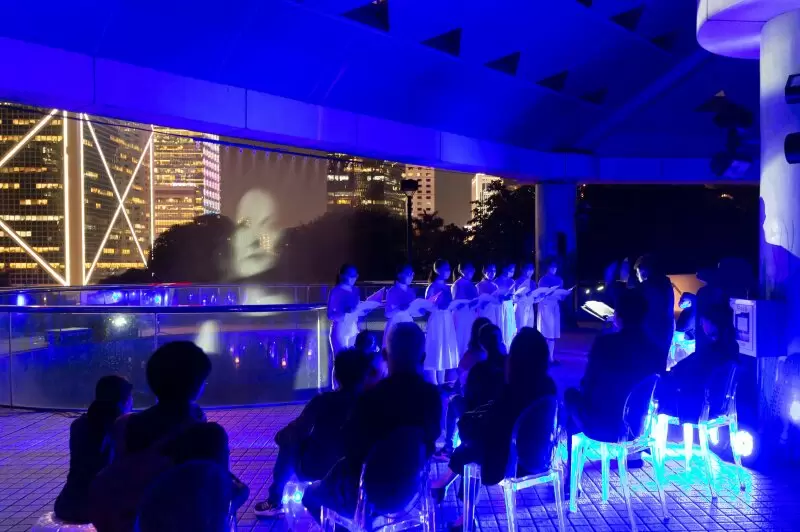
Image Courtesy: New Vision Festival, HKBU
As Ng looks toward the next decade—amid rapid technological change and shifting artistic landscapes—his focus remains steady. Taking technologies as resensitising tools in transdisciplinary undertakings, he will keep casting light on small gestures for subtle perceptions in quiet spaces where attention can grow. In a noisy world, his practice-led research suggests that perhaps one radical thing art can do is teach us how to listen.
Kouch, Koyo. “Biennale Arte 2026: Curatorial Text.” La Biennale di Venezia, May 27, 2025. https://www.labiennale.org/en/art/2026/curatorial-text-koyo-kouoh.