

Meet Our Rising Stars – Professor Liu Jin, School of Chinese Medicine
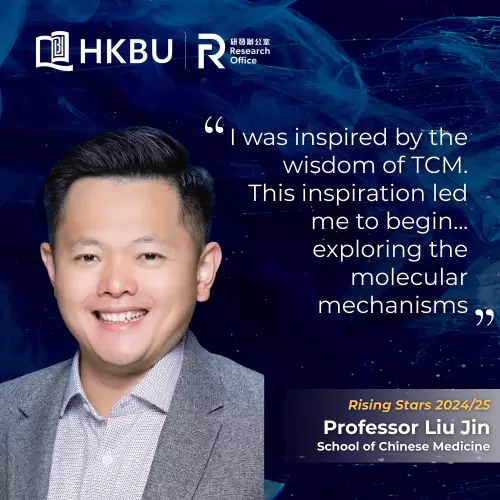
Professor Liu Jin's medical journey started in Western Medicine in Guangzhou. A shift occurred during his PhD at Hong Kong Baptist University (HKBU), where he began a new chapter dedicated to Chinese medicine.
Currently an Associate Professor in Chinese Medicine, he specialises in musculoskeletal diseases and cancer. His influential work has appeared in leading journals, including Nature Aging, Nature Communications, and Biomaterials.
The Research Office (RO) spoke with him to explore his career trajectory and his passion for Chinese medicine.
RO: What prompted your transition from Western Medicine to Chinese Medicine?
Liu: Before joining HKBU, I studied and was trained in Western medicine, focusing on bone and joint surgery. I then pursued a PhD in biomedical science at HKBU, where I was inspired by the wisdom of Traditional Chinese Medicine. This inspiration led me to begin my academic career exploring the molecular mechanisms of intercellular and trans-organ crosstalk, as well as related drug discovery in skeletal disorders and cancers.
RO: What project are you currently working on?
Liu: One of my current projects is funded by the Research Grant Council under the Early Career Scheme; it aims to explore how skeletal muscles communicate with bone in an exosome-mediated manner under mechanical unloading conditions and during aging. The project is expected to give rise to a novel therapeutic strategy for mitigating bone loss related to mechanical unloading.
I am also working on another project to develop novel small molecule inhibitors that suppress exosome secretion from tumour cells for sensitising anti-tumour immunity. It is expected to provide an alternative strategy for cancers resistant to the current immunotherapy.
RO: The project completed in HKBU that you are most proud of, and why?
Liu: Our recent study published in Nature Communications demonstrates that the excessive activation of glucocorticoid signalling in osteoblasts not only leads to bone loss, but is also a critical driver of systemic metabolic disorders in obesity. Significantly, we showed that osteoblast-targeted inhibition of 11β‑HSD1, an enzyme responsible for local glucocorticoid activation, effectively improved bone formation and metabolic health in an obese mouse model.
This discovery paves the way for a novel anti-obesity strategy to simultaneously strengthen bone and mitigate metabolic complications.
RO: What are some recent breakthroughs in cancer drug discovery you found particularly exciting?
Liu: Recent breakthroughs focus on smarter, more targeted therapies. Beyond the explosive progress in immunotherapies, two areas stand out.
First, Antibody-Drug Conjugate (ADC) technology is having a renaissance. Drugs like Enhertu deliver potent chemotherapy directly to cancer cells with unprecedented precision, redefining how we classify and treat tumours.
Second, the rise of molecular glues and protein degraders (PROTACs) offers a way to target "undruggable" proteins that drive cancer. These molecules force the cell's own disposal system to eliminate harmful proteins, opening doors to entirely new treatment strategies.
RO: Aptamer-based bone/tumour-targeting drug discovery is one of your research interests. How do you think the use of aptamer technologies can change the way we treat bone or joint diseases?
Liu: The aptamer technologies are significantly impacting the drug discovery and translational research in bone and joint diseases, such as the establishment of therapeutic aptamers targeting the specific domain of protein molecules that negatively regulate skeletal remodelling, and the development of aptamer-drug conjugates in which the aptamer could guide the cell-/ tissue-specific drug delivery.
The cell-penetrating capability of some aptamers is highly expected to facilitate selective binding to intracellular target proteins for inducing proteolysis targeting chimera (PROTAC), a revolutionary class of heterobifunctional small-molecule drugs that degrade disease-causing proteins rather than just inhibiting them.
RO: How have the University and your lab environment contributed to your research?
Liu: HKBU encourages researchers to adopt a transdisciplinary approach to problem-solving. Activities like research mingles provide academic staff with a social platform for exchanging scientific ideas and fostering collaboration across disciplines.
In our lab, we uphold values of mutual respect and continuous learning, where creative ideas are welcomed, and diverse perspectives are valued. Constructive mentorship and feedback from my supervisors, Professor Lyu Aiping and Professor Zhang Ge, are highly conducive to my intellectual growth. The team's enthusiasm, adaptability, and collaborative spirit in scientific discovery also motivate me to push boundaries and strive for excellence in my research journey.
RO: Quick advice to beginning researchers
Liu: Write a proposal or research paper from the perspective of a reviewer, emphasising the evaluation of criteria such as significance, clarity, and relevance. Alternatively, prepare a PowerPoint presentation targeting a general audience without a scholarly background, focusing on simplifying complex concepts and clearly illustrating key points.