

Meet Our Rising Star – Professor Lyu Xiaopu, Faculty of Arts and Social Science
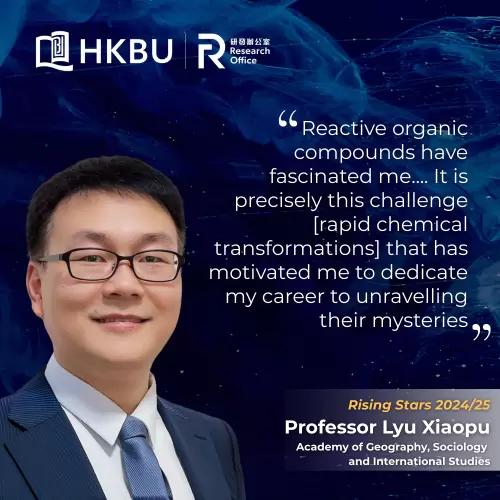
Professor Lyu Xiaopu, Assistant Professor at the Academy of Geography, Sociology and International Studies, is a specialist in atmospheric chemistry. An author of over 30 papers in leading journals, his research excellence has been recognised with important grants including General Research Fund (GRF) and National Natural Science Foundation (NSFC).
The Research Office (RO) spoke with him about his journey and the passion driving his impactful work.
RO: Could you tell us about your recent research?
Lyu: My current projects aim to better understand and ultimately reduce photochemical air pollution in the Greater Bay Area (GBA). One key project, which is funded by NSFC, focuses on secondary organic aerosol (SOA), a major component of PM2.5. We are building a scientific basis for the coordinated control of ozone and PM2.5 to support cleaner air strategies under China’s “dual carbon” (carbon peak and neutrality) goals.
RO: What inspired your focus on atmospheric reactive organics and air quality?
Lyu: Since I entered the field of atmospheric chemistry, reactive organic compounds have fascinated me – from toluene in traffic emissions and isoprene emitted by trees, to formaldehyde from interior materials and nonanal in cooking fumes. These compounds are not static; once in the atmosphere, they undergo rapid chemical transformations and become key precursors of ozone and secondary organic aerosol. Yet their composition, sources, reaction pathways, and emission controls are so complex that we still cannot confidently predict how to reduce their concentrations in the near future. It is precisely this challenge that has motivated me to dedicate my career to unravelling their mysteries.
RO: Which findings from your recent research could most significantly improve local air quality?
Lyu: I proposed the concept of the “Pearl River Estuary ozone pool”, elucidating how sea-land breeze circulation, when coupled with photochemistry, amplifies ozone pollution. My work has quantified the contribution of Southeast Asian emissions to summertime ozone in South China, as well as the enhancing role of the Beibu Gulf.
I also systematically assessed global ozone trends and control challenges, proposing a health-effect-oriented ozone–climate co-control framework. These findings carry significant policy implications for ozone pollution control in the GBA and beyond.
RO: The research you most proud of, and why.
Lyu: I'm most proud of a completed GRF-project investigating the "Rise in Summertime Ozone Levels in South China." Our key findings were significant: we quantified the impact of Southeast Asian emissions on regional ozone, discovered their amplification by the Beibu Gulf, and observed an unprecedented ozone decline starting in 2018—an early signal of air-quality improvement in the GBA linked to regional emission controls. This work resulted in ten SCI publications.
RO: How has the research environment at HKBU enhanced your work’s quality, scope, or impact?
Lyu: HKBU provides a robust environment that enhances both the quality and impact of my research. The University emphasises research excellence and offers incentives that foster ambitious, high-quality output. The Rising Star Research Grant, in particular, has been instrumental in initiating new research directions and accelerating their progress.
Additionally, HKBU’s equipment matching fund has strengthened our analytical and observational capabilities by supporting the procurement and upgrade of instruments. Access to the Advanced Life Sciences and Mass Spectrometry Laboratory further enhances our ability to investigate atmospheric chemistry at high resolution.
RO: How do the unique traits of your research team or lab environment inspire and assist you on your research journey?
Lyu: What I value most in my team is an honest, problem-driven mindset: we face scientific challenges directly and let evidence guide our decisions. Our lab’s strength lies in integrating complementary methods -- including field measurements, chemical transport modeling, and machine learning -- which allows us cross-validate findings and move from observation to mechanism and prediction. Above all, we encourage equal, open, and “heated” discussion: students and collaborators are empowered to challenge assumptions. This culture consistently enhances rigor, creativity, and overall quality of our research.
RO: Your advice to emerging researchers
Lyu: Think big questions and create a 10-year or longer plan. Focus on publishing high-quality papers, not just more papers. Most importantly, treat research as a long-term craft and hobby: building depth and resilience over time, not a blitzkrieg.