

Meet Our Rising Stars – Professor Zeng Hong, School of Creative Arts
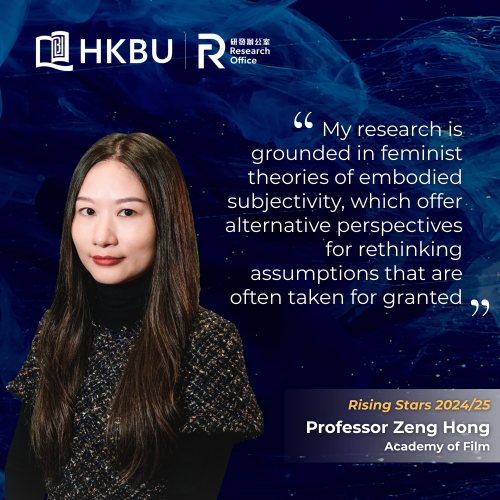
Professor Zeng Hong is an Assistant Professor at the Academy of Film and a cultural studies scholar whose work examines the dynamics of gender and spatial politics within visual culture.
Her articles have appeared in journals such as Cultural Studies, the European Journal of Cultural Studies, and the International Journal of Heritage Studies, reflecting her ongoing exploration of how ideologies shape creative industries—and the forms of resistance they provoke.
The Research Office (RO) recently spoke with Professor Zeng about her academic journey and the insights she has gained along the way.
RO: What project are you working on lately?
Zeng: My current major research project is “The Contemporary Art Ecosystem in the Pearl River Delta: A Case Study of Region-building and Worlding Practices”. It addresses a significant gap in scholarship on contemporary Chinese art and examines how a long-overlooked regional art ecosystem strives to define itself at a historical juncture, when Chinese state policy seeks to recast the Pearl River Delta (PRD)’s image from the low-end “world’s factory” to the higher-end vision of the Greater Bay Area as an “international innovation and technology hub” and global cultural megalopolis. The project investigates how government policies, entrepreneurial motivations, and the practices of art professionals intersect in the cultural construction of the PRD’s regional identity.
To date, three journal articles have been produced from this research and have been published or are forthcoming in Q1 journals, including Cultural Studies, Asian Studies Review, and European Journal of Cultural Studies.
RO: Your research explores gender and spatial politics in visual culture. Could you elaborate on your approach and current projects?
Zeng: I am a feminist scholar with an academic background in film studies and contemporary visual arts. My research is grounded in feminist theories of embodied subjectivity, which offer alternative perspectives for rethinking assumptions that are often taken for granted. An embodied approach foregrounds the subject’s spatial relationship to the world, emphasising that subjectivity is always situated and constituted across a wide range of spatial scales, from the domestic and the public to the urban and the rural, as well as translocal, regional, and global flows.
I began this line of inquiry in my PhD thesis, which I am currently developing into my first monograph, “Women Artists Reshaping Spatial Politics in Hong Kong”.
RO: Can you share an example of how ideologies in creative industries can generate resistance?
Zeng: One of my works, titled “Translocal Female Subjectivity: Notes on Ann Hui’s The Golden Era,” critiques the entrenched masculinity of auteurism as a theoretical framework in film studies, which privileges the notion of a director’s “coherent personal style” and has historically marginalised women directors, such as Ann Hui. This exclusion is particularly pronounced in the context of Hong Kong’s film industry, a predominantly commercial system oriented toward popular cinema, within which Hui’s fluid and adaptive filmmaking practices have been less easily recognised by canonical auteurist paradigms.
RO: What is your proudest project so far?
Zeng: It should be the article “Commoning Art for Sustainable Engagement with Hong Kong’s Existential Crises: A Case Study of Tak Cheong Lane Vegetarian Cooperative”. Published in Cultural Studies, the article introduces the original concept of “commoning art”—a novel theoretical contribution that blends socially engaged art practices with the politics of the commons and dissensual aesthetics. The article effectively situates its case—a collectively managed vegetarian restaurant and art space in a working-class Hong Kong neighbourhood—within urgent debates about how art can respond to compounded social, economic, and environmental crises. In doing so, it provides a rigorous case-to-theory model that moves beyond description to develop transferable theoretical insights.
RO: How has the research atmosphere at HKBU contributed to your development?
Zeng: HKBU’s strong emphasis on its foundational strengths in the arts and humanities has significantly enhanced my confidence in developing the quality of my research, as I feel that my work is genuinely valued within the institution. In particular, the newly established School of Creative Arts has fostered an intellectually vibrant environment that encourages creative practice grounded in critical thinking.
I am also deeply appreciative of HKBU’s commitment to transdisciplinary education, which has enabled me to strengthen the interdisciplinary rigour of my work in cultural studies and to broaden my research scope across the creative industries. In addition, the Research Office’s range of supportive schemes has provided important recognition of my research and, in turn, boosted my research productivity.
RO: What qualities of your research team have been the most motivational on your research journey?
Zeng: My research team has provided invaluable support throughout my research journey, from practical assistance—such as proofreading and formatting manuscripts—to archival research for my projects. At the same time, my younger team members often introduce me to emerging cultural products, including the latest games and recent cultural phenomena, which help keep me attuned to current cultural practices and continually stimulate my intellectual curiosity.
RO: For future generations of researchers, what do you wish someone had told you when you were starting out?
Zeng: I wish I had received guidance on navigating publication outlets early in my career; it took me quite some time to identify high-impact platforms. To better equip emerging researchers, I have delivered a dedicated workshop on this topic within the research seminar I teach.