

Meet Our Rising Stars – Professor Zhou Shuo, School of Communication
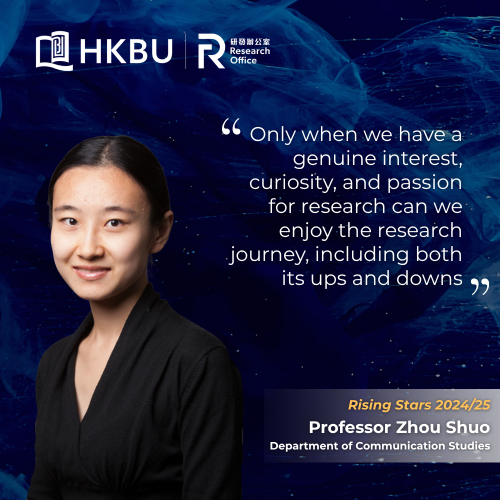
Associate Professor Zhou Shuo (Department of Communication Studies) specialises in technology-based health communication, with interests spanning social psychology, public health, and mobile health (mHealth) interventions. Her research has received support from organisations including the National Cancer Institute, National Heart, Lung, and Blood Institute, and American Cancer Society, Research Grants Council of Hong Kong and Health Bureau of Hong Kong.
The Research Office (RO) spoke with Professor Zhou about her aspirations in health communication research.
RO: What projects are you currently working on?
Zhou: One of my current research projects investigates whether and how reading mental health recovery stories impacts young adults’ psychological well-being. While strong evidence supports the effectiveness of a narrative approach in clinical settings and health campaigns, the understanding of how personal stories influence readers’ mental status is limited.
We therefore designed a public campaign and collected stories from university students who have lived experiences of struggling with and surviving from depression, anxiety, or other mental challenges.
Findings from this research will inform and optimise the design of cost-effective and scalable mental health promotion interventions to address the youth mental health crisis in Hong Kong and worldwide.
In another research project, we aim to construct machine learning models to predict suicidal thoughts based on linguistic, cognitive, emotional, socio-environmental, and behavioural factors and examine the feasibility of using Just-in-time Adaptive Interventions (JITAIs) for suicide prevention. Now we are developing a mobile phone app to track and monitor users’ suicidal risks and conducting the feasibility test. We hope the refined app could provide accessible, timely, personalised, and contextualised support to more effectively intervene suicidal thoughts and attempts and reduce the escalating suicide rate in HK.
RO: What inspired you to focus on technology-based health communication?
Zhou: People often think that health behaviour change is hard and requires a lot of willpower, but that is not always the case.
Well-designed technologies can facilitate behavioural changes and provide appropriate types and amounts of support at the right time when people are most in need of help. More importantly, I was drawn to technology-based health communication because immersive virtual environments, interactive storytelling, and games can embed health information in entertaining experiences to enhance people’s engagement, internalisation of health beliefs, and behavioural retention. Regardless of how technology evolves in the future, understanding how people perceive and interact with technologies and the persuasive mechanisms of technologies can always help us design more effective, accessible, and human-centred health interventions.
RO: How do mHealth interventions benefit society?
Zhou: In my studies, I have developed mobile phone apps to support smoking cessation, an AI agent to deliver culturally tailored messages to address people’s concerns about COVID-19 vaccines, a story-based intervention to improve awareness of food safety, and interactive videos to promote HPV vaccination.
For all these health issues, at-risk groups are disproportionally composed of ethnic minorities, low-income, and socially marginalised individuals, who are hard to reach in clinical settings and have a relatively high level of resistance to persuasion. With the rather easy access of mobile phones, mHealth can lower the barriers to healthcare and deliver behavioural nudges in everyday contexts to promote health beliefs.
RO: Tell us about the most significant project you completed at HKBU
Zhou: After joining HKBU, I conducted a series of studies that disentangled two often-conflated narrative processes—egocentric projection versus identification with story characters – and demonstrated that they operate through distinct psychological pathways with different persuasive consequences. Based on this framework, I further tested actor-observer asymmetry in immersive virtual environments.
I feel excited about this line of work as it offers a new perspective to investigate everyday social phenomena, extends the classic attribution theory to technology-mediated contexts, and provides new answers to old questions.
RO: How would you say the HKBU research environment has enabled you to deepen the impact of your work?
Zhou: HKBU emphasises interdisciplinary collaboration and organises a series of Research Mixer events. I am an active participant in these events; I love meeting colleagues across schools and faculties to explore innovative research directions and collaboration opportunities. Through these events, I got connected with scholars from linguistics, Chinese Medicine, physical education, translation, and computer science and initiated several interdisciplinary research projects.
Besides, HKBU provides diverse internal funding opportunities that support researchers to collect preliminary data, conduct proof-of-concept studies, and prepare for larger, external grants. This mechanism is especially helpful for long-term, large-scale, high-risk, high-benefit research projects to accumulate supporting evidence and establish track records.
RO: What mottos do you and your research team uphold to stay motivated?
Zhou: I think the most important principles guiding our research team are to keep learning and to maintain an open mind. When my supervisor retired a couple of years ago, he said to me, “Now I have more time to focus on research.” To him, research is not a job, but a part of his life. Now he still shares interesting research articles with me, and sometimes papers outside our field, for example, a mathematical framework that may contribute to an innovative way of operationalising social science constructs. Only when we have a genuine interest, curiosity, and passion for research can we enjoy the research journey, including both its ups and downs.

RO: Your wise words to future generations of researchers
Zhou: I encourage future generations of researchers to spend at least a few hours weekly to learn something that is interesting but may not be immediately useful. For example, researchers in social sciences could “waste” some time just observing people in parks, visiting museums or art exhibitions, solving mathematical problems, or reading popular books about physics. Even though these experiences might not be related to our current research topics, they can at least make you a better and happier person.