

Meet Our Rising Star – Professor Chen Ting, School of Business
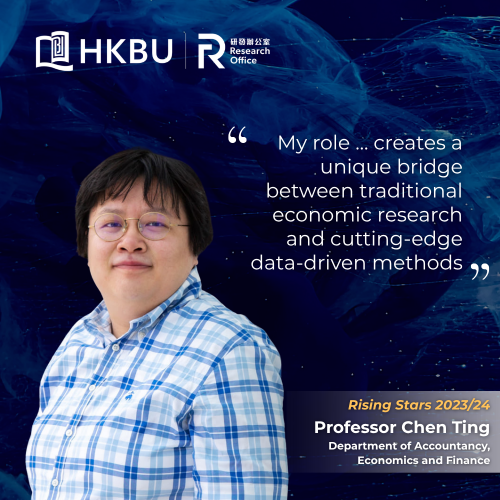
Professor Chen Ting serves as Associate Professor and Associate Head (Research) in the Department of Accountancy, Economics and Finance. Building on a postdoctoral fellowship at Princeton University’s Bendheim Center for Finance, her research intersects political economy and economic history. Her award-winning research, such as one on China’s imperial examination system that earned the 2020 Royal Economic Society Prize, appears in top-tier journals, including The Quarterly Journal of Economics, The Economic Journal, and The Journal of Politics.
Professor Chen talked to the Research Office (RO) about her great interest in economics and her considerable research experience.
RO: What is currently at the top of your research agenda?
Chen: My current key project, funded by the Rising Star Research Grant, is "Local Favoritism and Economic Reform: Evidence from Training GazetteerGPT on Thousands of Local Gazetteers". It investigates the driving force behind China’s post-1978 economic miracle—the role of local government officials and their personal networks in spearheading institutional changes during the reform and opening-up era—and also challenges the conventional assumption that local favouritism is solely a by-product of corruption and unfair resource allocation, revealing its nuanced and at times positive impact on economic reform.
A central innovation is the development of GazetteerGPT, a Large Language Model (LLM) trained on thousands of Chinese local gazetteers—the rich, county-level compendiums documenting local socio-economic and political histories, which have been very underutilised, and which enable the efficient construction of large-scale, structured datasets from historical archives.
The project’s significance extends well beyond political economy, and the datasets and tools produced will benefit researchers in history, sociology, and political science, creating a public good with broad interdisciplinary impact.
RO: Looking back at your time at HKBU, which project would you highlight as a career milestone?
Chen: I am most proud of "Long Live Keju! The Persistent Effects of China's Imperial Examination System", which The Economic Journal published in 2020. The paper shows that regions historically more exposed to China's imperial civil service examination system continue to exhibit higher levels of human capital accumulation today, over a century after the system was abolished.
It won the Royal Economic Society Prize for the best paper published in The Economic Journal that year, and was subsequently recognised with the Ministry of Education's Outstanding Achievement Award for Scientific Research in Higher Education in 2024. It exemplifies the kind of long-run institutional analysis that defines my research agenda.
RO: How has the institutional support or culture at HKBU helped shape your research trajectory?
Chen: HKBU provides an exceptionally supportive research environment. The university's commitment to research excellence, reflected in competitive start-up grants and sustained funding support, has allowed me to build a productive research program, and the university’s location in Hong Kong offers unparalleled access to archival materials and field research sites throughout China, while also serving as a gateway to international academic networks.
My role as Associate Director of the Centre for Business Analytics and the Digital Economy has facilitated interdisciplinary collaboration at the intersection of data science and economics, and HKBU’s recognition through the Young Researcher Award has also prompted me to pursue ambitious, high-impact research questions.
RO: What stands out as the most positive feature of your research environment?
Chen: I would say it is the breadth and depth of my collaborative network that the environment enables. I work with co-authors across world-class institutions, which include Princeton, the LSE, the IMF, HKUST, Peking University, and many others, in political economy, urban economics, economic history, and data science. This diversity of expertise permits me to tackle complex, multi-dimensional questions that no single discipline could address alone.
Within HKBU, my dual role in the economics department and the Centre for Business Analytics and the Digital Economy creates a unique bridge between traditional economic research and cutting-edge data-driven methods, which encourages me to continue to expand the methodological frontier of my work.
RO: How do you unwind and cool off from teaching and research?
Chen: I enjoy hiking the scenic trails around Hong Kong, which offers a refreshing counterbalance to academic work. Regular outdoor activity helps me recharge creatively and maintain perspective. I also believe in setting clear boundaries between research time and personal time, allowing both to thrive.
RO: One valuable lesson you learned along the way in your research?
Chen: Let your teaching and research feed each other. Since joining HKBU, I have taught a course on machine learning and textual analysis, which pushed me to explore the latest developments in LLMs and AI, and that investment is now paying dividends in my own research—I have multiple projects that use the power of LLMs to compile massive datasets from historical archives, including building a GazetteerGPT. Teaching keeps you at the frontier, while research gives your teaching purpose.