
跳到主要内容
news

Beyond the canvas: the forgotten stories of deaf and blind masters of the Renaissance – Interview with HSSPFS and GRF recipient Professor Angelo Lo Conte

返回

1


By unearthing the lost stories of deaf and blind artists in early modern Europe, Hong Kong Baptist University’s Professor Angelo Lo Conte is challenging centuries of misconceptions about disability. Backed by a rare double award of prestigious UGC grants, his groundbreaking research reveals a Renaissance society that was surprisingly empowering.


Professor Angelo Lo Conte is on a mission to reframe the history of art and disability. An art historian at Hong Kong Baptist University’s (HKBU) Academy of Visual Arts, Professor Lo Conte has dedicated the past seven years to uncovering the often-overlooked professional careers of deaf and blind artists working in 16th- and 17th-century Europe. His pioneering research—which shifts the focus from how individuals with disabilities were represented in art to the live stories and professional experiences of artists with sensory disabilities themselves—has recently earned him a rare double accolade from Hong Kong’s University Grants Committee (UGC): the Humanities and Social Sciences Prestigious Fellowship Scheme (HSSPFS) and the General Research Fund (GRF).


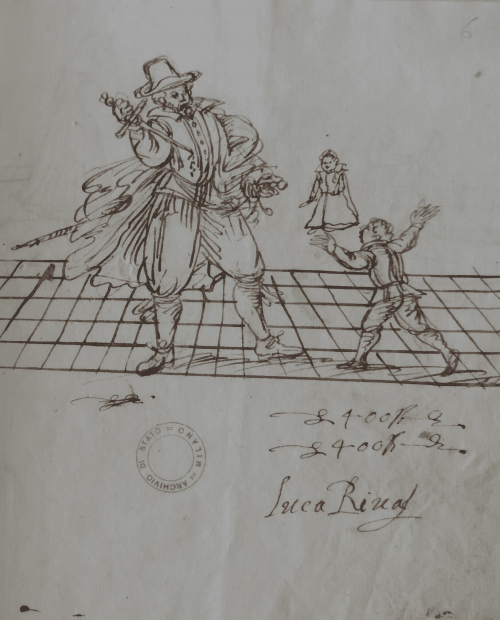
The catalyst for this monumental, multi-award-winning project was a serendipitous discovery. While researching the workshop and the financial networks of a prominent Milanese family during his PhD. studies, Professor Lo Conte found a 17th-century legal document unlike any other. It was a last will and testament, but it wasn’t written with words. Instead, it was composed entirely of a set of 10 elegant drawings.


1

Figure 1: Luca Riva, Felice Riva and his sons, 1624, brown ink on paper. In Il testamento di Luca Riva, 9 Settembre 1624 (Milan, Archivio di Stato, Cimeli, Appendici, 10)


The author, Luca Riva, was a 33-year-old artist. Born deaf in an era before the creation of formalised sign languages and deaf education, he could not speak. Yet, to make sure that his family would receive their inheritance, he used the one language he had mastered: his art.


“Those drawings were interpreted in the presence of notary and then passed to a judge, who accepted this disposition as a legally binding document,” he explains. “This is incredibly important. In Italian law, drawn images (especially when used to replace uttered words) have only became legally binding in the second half of the 20th century. Here we are talking about the 17th century. It shows a society that perhaps was much more progressive and accommodating than we assume.”


This unusual archival discovery sparked a profound question: If a deaf artist could thrive in a prestigious 17th-century workshop, could they really have been the only one?


1
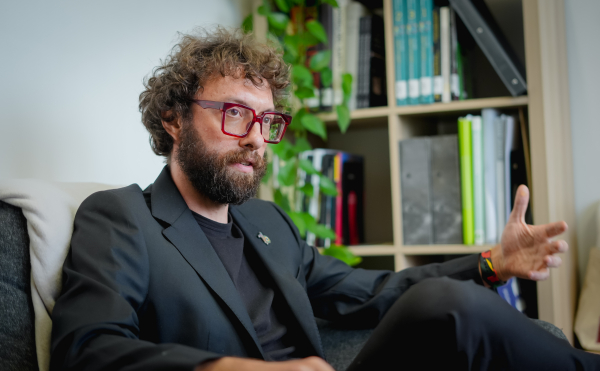
Professor Angelo Lo Conte, Academy of Visual Arts

The answer, it turns out, is a resounding no. Supported by his UGC fellowships, Professor Lo Conte's upcoming monograph promises to challenge many of the modern assumptions that often cloud historical analyses of disability.“Scholars have tended to assume that a person born with a sensory disabilities in premodern eras would have  been necessarily destined for a marginalised life without opportunities,” he says. “While that might have certainly been true in some cases, this was not the rule. In the world I am analysing, the word ‘disability’ did not exist; it had no meaning. What mattered was a person’s ability to be a member of society, to have a family, and to provide for them.”

Through what historians generally call "ego documents"—wills, contracts, and personal letters—Professor Lo Conte pieces together the lived experiences of these artists. His research reveals that participation in the arts was heavily influenced by a combination of intersectional factors such as gender, socio-economic background, and geographical mobility, rather than physical ability alone.


1

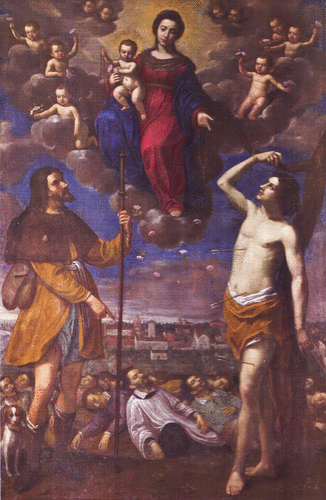
Figure 2: Ercole Sarti, The Virgin Angels with Sts. Rocco and Sebastian (or Virgin of the Plague), church of Sant’Antonino Martire, Ficarolo, ca. 1630. Oil on canvas. Photo: Luciano Pigaiani. 


He points to the contrasting beginnings of two deaf Renaissance painters: Ercole Sarti and Filippo Ceppaluni. Sarti, hailing from a wealthy northern Italian family with an established art collection, was recognised for his talent early on and placed to study top-tier artistic workshop. He enjoyed a successful career and was very selective in his commissions. Filippo Ceppaluni, born in southern Italy, was likely abandoned as a child and taken into a painter's household as a workshop helper. Yet, through sheer talent and exposure to the trade’s secrets, he climbed the social ladder to work for many important patrons in Naples.


Both men were deaf. Both could not speak. Both forged successful careers.


“If we stick to the traditional historical view of disability, it is difficult to explain this, because formalised deaf education supposedly only started later,” Professor Lo Conte points out. “But we are discovering that the use of gestural communication and early modern sign lexicons was much more widespread in the past than we thought.”


The flexibility of historical workshops might have extended to blindness as well. He shares the remarkable story of Giovanni Gonnelli, a highly established 17th-century sculptor in Rome who gradually lost his sight. Unable to carve hard stone or marble, Gonnelli adapted. He began working exclusively in clay. By touching the faces of his subjects, he memorised their features and reproduced them with astonishing accuracy.


“The only thing he couldn't do well was the pupils of the eyes, which he would render by making a mark with a straw,” He notes. “At a first glance, the portraits look strange because of this particular rendering of the eyes, but the features are incredible. Throughout his career, he remained an incredibly famous and successful artist.”


Backed by his UGC funding, he is preparing for extensive archival trips across Europe—from Milan and Naples to Amsterdam and Antwerp—to finish his book. Concurrently, he will be translating his academic findings into an accessible podcast series, complete with sign language translation, to bring these neglected narratives to the public.


For modern society, the implications of unearthing these stories go far beyond the confines of art history.


"Looking at the past is a way to understand ourselves"


Professor Lo Conte reflects. “I think many people have no idea that artists with different kinds of sensory disabilities produced highly refined artworks in the past. Knowing this brings a new awareness: if this was possible in the past, it's certainly possible in the world we are living in today.”


By revealing a Renaissance society that could be remarkably accommodating and deeply appreciative of diverse talents, Professor Lo Conte is doing more than saving some masters from obscurity. He is providing a powerful, empowering narrative that proves human ingenuity has always found a way to make its mark on the canvas of history.
 

Beyond the canvas: the forgotten stories of deaf and blind masters of the Renaissance

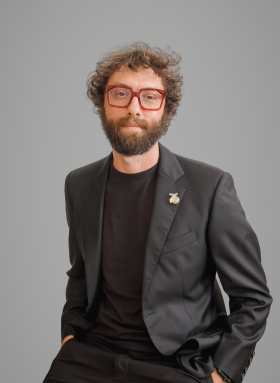
Professor Angelo Lo Conte

Academy of Visual Arts


Professor Lo Conte’s research profile: https://scholars.hkbu.edu.hk/en/persons/ANGELOLOCONTE


Reference List:

  • Figure 1: Lo Conte, A. (2022). A visual testament by Luca Riva, a deaf and mute pupil of the Procaccini. Renaissance Studies, 36(2), 222-251. https://doi.org/10.1111/rest.12730
  • Figure 2: Lo Conte, A 2022, 'Talking colours: Ercole Sarti and the verses that gave voice to his paintings', Source: Notes in the History of Art, vol. 41, no. 4, pp. 255-266. https://doi.org/10.1086/722322