

Meet Our Rising Star – Professor Shi Jingyuan, School of Communication
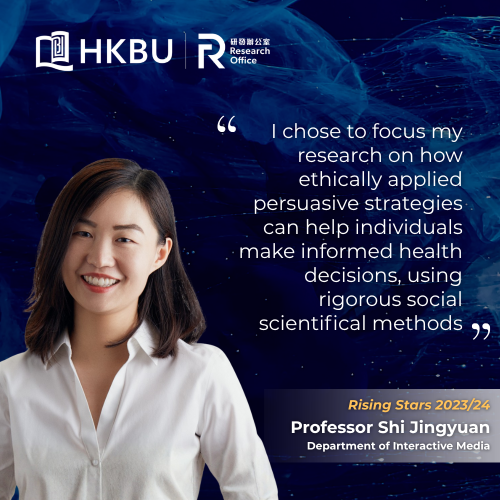
Professor Shi Jingyuan, Associate Professor, Department of Interactive Media, bridges persuasion, health communication, and emerging communication technologies, exploring how new digital tools transform social influence and can be leveraged for the social good.
Professor Shi’s theory-driven work addresses critical global challenges, from vaccination and mental well-being to cancer awareness and climate change, and her international honours include the Top Paper Award from the International Communication Association, and the Promising Professor Award from the Association for Education in Journalism and Mass Communication. An expert adviser to the World Health Organization and holder of a University Grants Committee research grant, the professor is a leading voice in examining digital media's impact on youth and public health.
The Research Office (RO) met with Professor Shi to explore the vision and dedication driving her research into digital media and public health.
RO: Tell us about one of your ongoing projects
Shi: One of my current research projects centres on investigating the potential of large language model (LLM)-based chatbots to communicate essential information about influenza and its vaccines, with a particular focus on reducing vaccine hesitancy among the public. In this project, we have designed and developed a retrieval-augmented generation (RAG) LLM-based chatbot capable of generating flu vaccine promotion messages that are both accurate and grounded in the latest, evidence-based scientific findings. To enhance the effectiveness of the chatbot, we have programmed it to incorporate a variety of persuasion strategies, allowing it to tailor its messages according to users’ needs, concerns, and levels of understanding.
A key strength of our approach lies in the chatbot’s adaptability and its ability to provide reliable information in an accessible, conversational format. In the upcoming phase, we plan to rigorously test the chatbot’s impact and user engagement in both English and Chinese language contexts, further broadening its reach and relevance to local communities.
Ultimately, my aspiration for this project is to deliver an effective and ethical LLM-based chatbot solution that offers real-time, personalized communication about flu vaccines, thereby alleviating concerns and reducing vaccine hesitancy.
RO: What led you to focus your research on the intersection of persuasion and health communication?
Shi: My interest in the intersection of persuasion and health communication is rooted in a desire to understand how communication shapes people’s attitudes and behaviours, especially in ways that promote overall well-being. When I was an undergraduate, I majored in Journalism and minored in Economics; my journalism background heightened my awareness of social issues, while economics provided me with a foundation in social science principles. Guided by my mentors, I chose to focus my research on how ethically applied persuasive strategies can help individuals make informed health decisions, using rigorous social scientifical methods. The potential to create tangible benefits, such as boosting vaccination rates or improving young people’s mental wellbeing, continues to inspire and motivate my work.
RO: What do you see as the biggest challenge in using digital media to reach and engage young people on health-related issues?
Shi: Young people are digital natives, spending a significant part of their lives online and exposed to endless content vying for their attention. Because they are generally in good health compared to older populations, they may not perceive health information as immediately relevant. This lack of perceived personal relevance, combined with information overload, often leads to disengagement or information avoidance.
To effectively reach and engage young people, health communication partitioners need to understand their interests, values, and digital media use habits. In addition, employing some interactive and novel digital media, such as video games and virtual reality, could be a promising means to communicate health issues with young generations.
RO: Of all your research at HKBU, what are you most proud of?
Shi: The project I am most proud of explored how to encourage young people to seek help with mental health issues. Collaborating closely with my co-authors, we conducted a series of studies—from examining the motivations behind seeking mental health support to testing the effects and underlying mechanisms of social media messages and conversations on young people’s attitudes and intentions toward help-seeking. I am particularly drawn to these studies on mental well-being because they combined rigorous research design with meaningful, real-world applications. They also provided me with a deeper understanding of my students, who fall within this age group and are highly susceptible to mental health challenges. This project stands out not only for its academic contributions, but also for its potential to inform new strategies to support youth mental health both on campus and in the wider community.
RO: How has the research environment at HKBU supported and shaped your work?
Shi: The research environment at the School of Communication and HKBU is highly supportive, fostering meaningful interdisciplinary collaboration. For instance, research events and activities organised by the Research Office provide excellent opportunities for scholars to exchange ideas, share their work, and form collaborative partnerships. HKBU’s strong focus on impactful research has inspired me to translate my findings into practical recommendations that promote social good, including encouraging health-promoting behaviours and advocating for pro-environmental actions.
RO: How do you maintain a healthy boundary between your research agenda and personal life?
Shi: I enjoy spending quality time with my family and making a conscious effort to limit my use of social media. Although my research focuses on social media and communication technologies, I find, like many others, that it can be easy to become overly engaged or even addicted to these platforms. I recognise the challenge, but I strive to avoid social media during my personal time and maintain clear boundaries between work and leisure. I hope this could help me sustain both my productivity and my overall well-being.am passionate about mountaineering, diving, and running. I view work and life as symbiotic: vigorous outdoor activity revitalises my body, while research sharpens my mind. Together, they fuel my enduring drive and enthusiasm for both discovery and daily life.
RO: For a future generation of researchers, what do you wish someone had told you when you were starting out?
Shi: I wish someone had emphasised the importance of staying optimistic. Research often involves setbacks and unexpected outcomes, but staying optimistic supports mental wellbeing and fosters resilience. Looking back, I am grateful for collaborators who encouraged me to revise and resubmit my work after rejections. Their support helped me grow and succeed in academia.