

Meet Our Rising Star – Professor Xavier Wong, School of Chinese Medicine
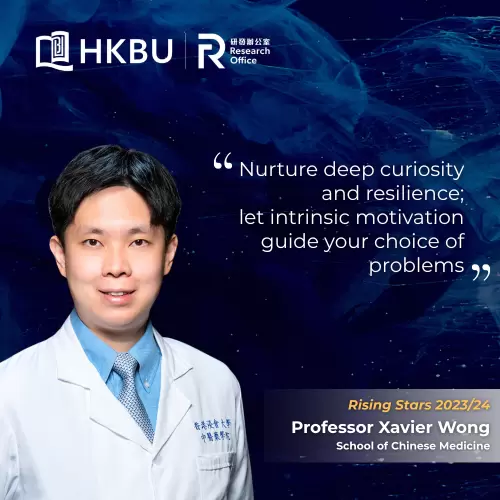
As a Professor in Chinese Medicine - Teaching and Research Division and principal investigator, Professor Xavier Wong leads research teams with diverse expertise, including biology, neuroscience, and microbiome research. He collaborates with clinicians and bioinformaticians, producing groundbreaking work published in top-tier journals such as Nature Communications, Cell Host & Microbe, and Nature Metabolism.
Professor Wong has successfully secured over HK$20 million in research funding from competitive grant schemes in Hong Kong, Europe, and the Mainland to support the multidisciplinary translational research his teams are pursuing.
The Research Office (RO) sat down with Professor Wong to explore his journey as both an individual researcher and a research team leader.
RO: What is the primary question your current project is trying to answer?
Wong: My research delves into the dynamic cellular microenvironment, with a keen focus on the extracellular matrix (ECM) and its remodelling enzymes, particularly matrix metalloproteinases (MMPs). We identified MT1-MMP as a central regulator of key signalling pathways and, more recently, as an orchestrator of cellular metabolism that maintains energy homeostasis via the GDF15/GFRAL axis.
These studies show that MT1-MMP–driven proteolysis actively modulates signalling and contributes to age-related metabolic disease, heightened COVID-19 susceptibility, and neurodegeneration. By reframing proteolysis from a purely degradative process to a precise regulator of signalling, our work reveals convergent therapeutic targets across multiple age-related conditions.
RO: What inspired you to focus on the relationships between proteases and metabolic disorders in your research?
Wong: My focus on proteases and metabolic disorders stems from the urgent need for safer, non-invasive alternatives to treat obesity, a global driver of diabetes, cardiovascular disease, and some cancers. While bariatric surgery can produce durable weight loss, it is invasive, costly, and often accompanied by lifelong complications, underscoring the need for mechanism-based therapies.
Proteases—especially the membrane-bound metalloproteinase MT1-MMP (MMP14)—offers a compelling entry point. MT1-MMP orchestrates extracellular matrix remodelling, liberates growth factors and cytokines, and sheds cell-surface receptors, positioning it to reshape metabolic signalling and tissue homeostasis. Moreover, human genetics links MMP14 variants to obesity and diabetes traits, and mutations cause Winchester syndrome, highlighting its physiological importance. Yet the molecular pathways connecting MT1-MMP to body-weight regulation remained largely unresolved.
This convergence of clinical need, biological plausibility, and unanswered questions inspired my lab to interrogate how protease-mediated cues govern energy balance and fat metabolism in health and disease.
RO: Looking back on your time at HKBU, is there a breakthrough that feels particularly meaningful to you?
Wong: I would say it is the discovery that MT1-MMP controls systemic energy homeostasis via the GDF15/GFRAL axis. Published in Nature Metabolism (2022) and extended by follow-up studies, the study shows that MT1-MMP–driven proteolysis rewires signalling, influencing obesity, diabetes traits, COVID-19 susceptibility, and neurodegeneration. By reframing proteolysis as precision signalling, the work reveals convergent, druggable targets across age-related diseases and has catalysed industry partnerships to develop small-molecule, biologic, and herbal-derived therapeutics for obesity and fatty liver disease.
RO: What do you see as the most promising applications of your research in translating findings to drug discovery and Traditional Chinese Medicine (TCM)?
Wong: Leveraging our protease findings, we co-develop small molecules, biologics, and herbal-derived therapeutics for obesity and fatty liver disease with pharmaceutical partners. Using AI-enabled, multi-parameter screening, we prioritised artesunate, a TCM derivative, for anti-obesity repurposing.
In parallel, we identified a novel herb-derived plant pigment that ameliorates non-alcoholic fatty liver disease by reshaping the gut microbiome and improving liver metabolic health. We are optimising formulation and safety profiling and exploring microbiome biomarkers to guide patient stratification.
Together, these programs showcase how integrating TCM with modern AI, chemical biology, and translational pipelines can deliver innovative, mechanism-based interventions for global metabolic health.
RO: What makes HKBU a supportive home base for the kind of interdisciplinary work you do?
Wong: HKBU’s interdisciplinary environment that bridges Chinese medicine, life sciences, and data science has amplified the quality, scope, and impact of my work.
Cross-faculty collaborations enabled AI-driven screening and the integration of TCM with modern translational research, directly informing our artesunate and plant-pigment programs for obesity and fatty liver disease. Supportive internal funding, outstanding postgraduate talent, and a proactive knowledge-transfer ecosystem accelerated IP protection, industry partnerships, and preclinical development. Clinical and community networks further enhanced relevance, allowing us to move rapidly from mechanistic discovery to drug candidates with clear pathways toward patient benefit.
RO: What unique qualities of your research environment most inspire and support you on your research journey?
Wong: Graduate student involvement is a cornerstone of my research program. I cultivate a rigorous, supportive training environment that emphasises experimental design, quantitative analysis, and translational impact, with opportunities to collaborate with clinical and industry partners.
We embrace HKBU’s unique blend of TCM and modern biomedicine, which fuels creative hypotheses and translational thinking. Close ties with clinicians and industry keep us patient-focused and solution-oriented, while outstanding core facilities and research support let ideas scale quickly.
Above all, the team’s curiosity, kindness, and resilience create a safe space to take bold risks and turn failures into insights.
RO: Any wise words for the beginning researchers?
Wong: A research career is challenging. It’s a vocation, not just a job. Nurture deep curiosity and resilience; let intrinsic motivation guide your choice of problems. Fail often, learn quickly, and be patient—impact comes from sustained, focused effort over years.