

HKBU study reveals how different components of atmospheric fine particles combine or clash to harm your lungs
.png)
Breathing polluted air filled with fine particulate matter (PM2.5) is known to cause lung problems, heart disease, and other health issues, but scientists have long wondered: why some PM2.5 is more toxic than others? A recent study led by Professor HU Di from the Department of Chemistry dug deeper by breaking down real-world PM2.5 collected in Shenzhen, China, into its main chemical parts, i.e., water-soluble metals, water-soluble non-metals, water-soluble total fraction, lipid-soluble compounds, and the full PM2.5 mixture.
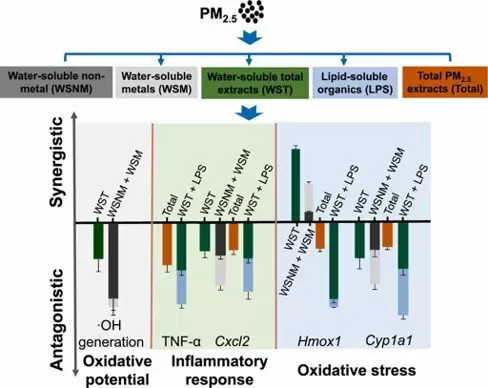
The individual and combined effects of chemical fractions on PM2.5-induced toxicity, including oxidative potential and inflammatory response
The team tested how these different fractions affect oxidative stress (a kind of cellular rusting caused by reactive oxygen molecules), inflammation, and gene activity in cells that mimic those in our lungs. The key findings include:
- Water-soluble metals are the main drivers of redox activity indicated by Dithiothreitol (DTT) consumption, while organic compounds are more responsible for generating harmful hydroxyl radicals;
- The water-soluble total fraction (everything that dissolves in water) was the most dangerous overall. It triggered the strongest inflammatory response (highest TNF-α release) and strongly activated genes linked to oxidative stress (Hmox-1) and toxin metabolism (Cyp1a1);
- There were interesting interactions: metals and organics together sometimes amplified protective stress-response genes (synergistic on Hmox-1) but suppressed certain inflammatory signals (antagonistic on Cxcl2);
- The fat-soluble fraction generally had weaker or even dampened inflammation and oxidative stress signals induced by the water-soluble parts.
In simple terms, this research shows that it is not just how much PM2.5 is in the air, but what chemicals it contains that determine how harmful it is. Water-soluble components, especially the mix of metals and organics, appear to be the main troublemakers for lung cells. These interactions are complex: sometimes the chemicals boost each other’s toxicity, and sometimes they partially cancel each other out. This helps explain why air pollution from different cities or seasons can have varying health impacts and provides important clues for better air quality regulations and health protection strategies.
These research findings have been published in Environmental Pollution (Barking, Essex: 1987) under the title “Synergistic and antagonistic effects of PM2.5 chemical fractions on oxidative potential, cellular inflammation, and gene expression”.

Professor Hu Di
Department of Chemistry
Professor Hu’s research profile: Professor Hu Di - Hong Kong Baptist University
This article was originally published by the Faculty of Science.