


HKBU team led by Professor Wang Shu-jen develops novel nanostructured coating patterned with metallic cross-shaped structures to boost solar power efficiency for spacecraft
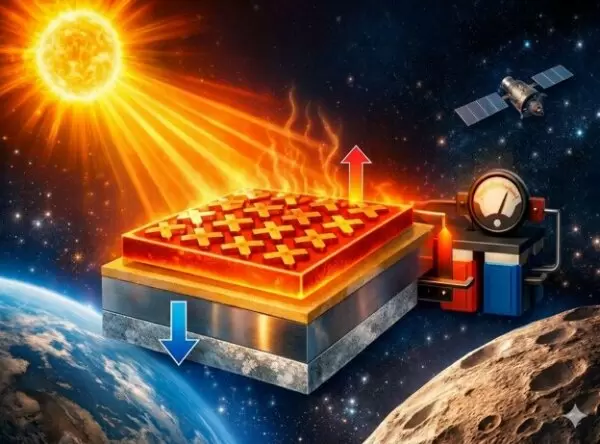
A nanocross photonic metamaterial absorber captures sunlight in Space and converts it into localised heat, increasing the temperature difference across a thermoelectric generator to support enhanced electrical power generation for compact spacecraft and autonomous sensors
Space missions need power systems that can keep working for years, or even decades, with little or zero maintenance. Thermoelectric generators (TEGs) are important because they can turn a temperature difference directly into electricity and have no moving parts. Their main limitation is simple: if the temperature gap is small, the electrical output is small too.
Professor WANG Shu-jen from the Department of Physics led a team of researchers to tackle this challenge with a new nanostructured coating called a photonic metamaterial (PtMM) absorber. The coating uses ultra-thin layers of industry-compatible materials, and is patterned with tiny metallic cross-shaped structures. Instead of letting sunlight bounce away, this surface is designed to trap it very efficiently and convert it into concentrated local heat exactly where a thermoelectric device needs it most – on its hot side. The result is a larger temperature difference between the hot and cold sides, which can translate into more electrical power. The paper reports that the optimised nanocross design reaches about 99% peak light absorption and more than 95% average absorption across the visible range.
.png)
This figure shows the proof-of-patternability (geometry feasibility) of the NC-PtMM geometry with e-beam lithography at IIT
This is exciting because it points to a practical new way to support power generation for compact space technologies such as CubeSats, planetary landers, and autonomous sensors, without redesigning the thermoelectric material itself. Because the concept is based on standard thin-film materials and microfabrication routes, it also offers a realistic pathway from simulation and design to future testing and space applications.
The research findings have been published in Physical Chemistry Chemical Physics (PCCP) under the title “Near-unity broadband photonic metamaterial absorber for thermoelectric energy harvesting in Space”.

Professor Wang’s research profile: Shu-Jen WANG - Hong Kong Baptist University
This article was originally published by the Faculty of Science.
Previous News