

Developing an AI-enhanced storytelling library for marginalized voices – Updated review, prototype creation, and prospective influence
Project Websites
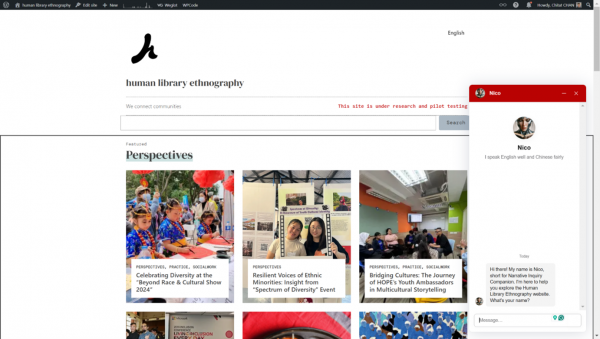
For public: https://humans.asia/
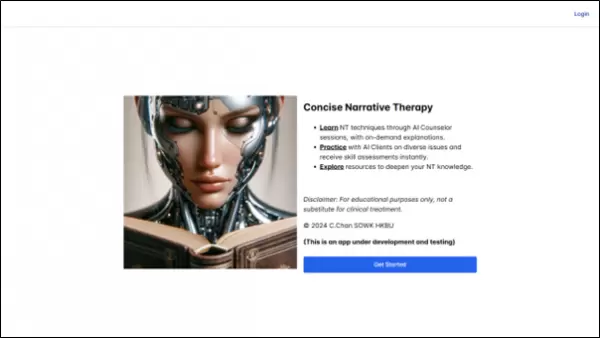
For training interviewers and reporters: https://app.nicos.asia/
Project Description
Background: Prejudice, both self-directed and outward, leads to numerous personal and social challenges, such as discrimination and social exclusion. These experiences, particularly those of ethnic minorities, provide a compelling focus for this project. Theoretical foundation: Proactive inquiry and reflective dialogues reduce prejudice more effectively than didactic teaching. Thoughtful questions prompt personal introspection and openness to diverse viewpoints. Narrative practitioners use sequenced questions for reflection, a process our customised AI chatbots can co-work together and facilitate.
Objectives: 1) Conduct a scoping review to explore generative AI applications in social interventions. 2) Develop a prototype for an AI-enhanced storytelling library that highlights the experiences of marginalised communities, particularly ethnic minorities in HK. 3) Evaluate the outcomes and potential impact of this innovative approach on participants, including story contributors, youth reporters, and readers. App development (the interventions): The project features two interrelated platforms, both integrating AI to enhance their functionality. First, http://humans.asia – A public platform designed to amplify ethnic minority voices. AI is central to this platform, supporting narrative inquiry, story production, automated translations, and reader engagement through interactive, reflective questioning. Second, http://app.nicos.asia – A specialised training platform for interviewers and reporters. AI facilitates narrative interview techniques, provides on-demand skill-building tools, and offers personalised feedback to enhance users’ interviewing capabilities.
Participants: The project engages diverse participant groups and employs multifaceted methods to evaluate its impact. (a) For story contributors, the focus is on how sharing narratives influences self-perception and empowerment. (b) Youth reporters’ development of narrative interviewing skills and attitudes toward diversity will be assessed, (c) alongside readers' engagement with AI-enhanced storytelling and their growth in empathy and reflective thinking.
Research Methods: This complexity necessitates a mixed-methods approach, combining qualitative insights and quantitative insights. Qualitative evaluation includes in-depth interviews and content analysis to explore participants’ self-perceptions, attitudes, and skills. Quantitatively, different sets of RCTs will also target the three participant groups (story contributors, youth reporters, and readers).
Significance: This project amplifies marginalised voices, equips youths with narrative skills, and fosters public empathy through interactive AI storytelling. It promotes interdisciplinary collaboration among social sciences, humanities, and computing, supporting future developments, studies, and business models. Ultimately, it aims to build a more inclusive HK society.
Project Investigator
Professor CHAN Chitat, Larry (Academy of Wellness and Human Development)
Project Collaborators
- Professor CHOW-QUESADA Shun Man, Emily (Academy of Language and Culture)
- Professor Daisy D S TAM (Academy of Language and Culture)
- Dr Marija TODOROVA (Academy of Language and Culture)
- Professor YU Chuan (Academy of Language and Culture)
Professor KWONG Chi Man (Academy of Chinese, History, Religion and Philosophy)
Professor LEE Wan Ping, Vincent (Academy of Wellness and Human Development)
Professor Kaxton Y SIU (Academy of Geography, Sociology and International Studies)
Professor Lauri GOLDKIND (Associate Professor, Graduate School of Social Service, Fordham University, USA; Chief Editor of the Journal of Technology in Human Services)
Publications
- Chan, C., & Nurrosyidah, A. (under review). Democratizing AI for social good: A bibliometric-systematic review through a social science lens. Social Sciences (Q2 CiteScore Best Quartile)
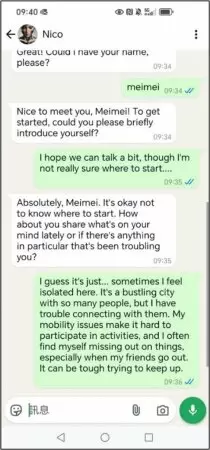
- Chan, C., Zhao, J., & Zhao, Y. (2024). Our journey with an AI assistant offering narrative therapy on WhatsApp. Journal of Social Work Practice. https://doi.org/10.1080/02650533.2024.2420314 (Q1 CiteScore Best Quartile)
- Chan, C., Zhao, Y., & Zhao, J. (2024). A case study on assessing AI assistant competence in narrative interviews. F1000Research, 13. https://doi.org/10.12688/f1000research.151952.2 (Q1 CiteScore Best Quartile)
- Chan, C. (2024). Teaching about marginalized groups using a digital human library: Lessons learned. Social Sciences, 13, 308. https://doi.org/10.3390/socsci13060308 (Q2 CiteScore Best Quartile)
- Chan, C., & Li, F. (2023). Developing a natural language-based AI-chatbot for social work training: an illustrative case study. China Journal of Social Work, 1-16. https://doi.org/10.1080/17525098.2023.2176901 (Q2 CiteScore Best Quartile)