

Meet Our Rising Stars – Professor Zhou Kaiyang, Faculty of Science
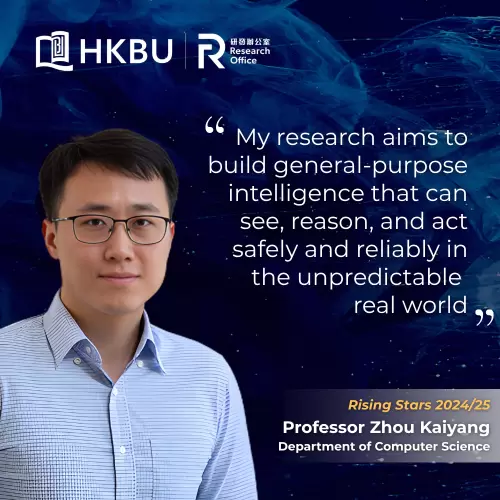
Professor Zhou Kaiyang, Assistant Professor in the Department of Computer Science at HKBU, channels a passion for innovation into research spanning machine learning, deep learning, and video understanding.
Recognised by Stanford University among the world’s top 2% scientists, his work has made substantial impact. In a recent conversation, the Research Office spoke with Professor Zhou about his research journey at HKBU and his vision for the future of these fields.
RO: What are your primary research interests?
Zhou: My research aims to build general-purpose intelligence that can see, reason, and act safely and reliably in the unpredictable real world.
"See” means teaching AI to understand the world through vision. We hope the machine can grasp both global semantics and local details within each image. “Reason” refers to the ability to do deep thinking using vision and language, and potentially other modalities, such as sound. “Act” requires AI to precisely translate visual understanding and reasoning into actionable signals.
My research mainly adopts the data-driven approach, that is, developing machine learning models that can learn patterns and behaviours from data, with limited human supervision, and generalise across domains.
RO: What is your latest project, and what stage is it currently at?
Zhou: My current key project is about long video understanding and interaction.
The project aims to develop AI that can help us quickly understand long videos and interact with users through natural language; it focuses on three key abilities: real-time interaction, reasoning, and memory.
Real-time interaction means the AI should be capable of processing streaming video and engaging with users in real-time, answering questions related to the present, past, or future. Reasoning refers to the model’s ability to think, such as decomposing problems into sub-problems or employing common sense and knowledge to analyse problems. Memory is a challenge, concerning how much past information the AI encode and retains.
Currently, we’ve done preliminary research in terms of real-time interaction and reasoning, with some research outputs already submitted to top-tier conferences for review. We’re working on the memory part and hope we can overcome this problem soon.
RO: Could you highlight your team’s most significant discoveries?
Zhou: Our team was among the first to study multimodal reasoning using reinforcement learning.
We developed a simple multimodal reasoning model, “Visionary-R1”, which conducts a deep analysis of images before engaging in reasoning— all accomplished through reinforcement learning without the need to curate reasoning data.
Visionary-R1 performed very well on visual reasoning benchmarks. Building on this success, we invented the dual-mode thinking model, DualMindVLM. It can automatically switch between slow and fast thinking modes depending on the complexity of the problem.
RO: How has the research environment at HKBU empowered you to continually strive for greater achievements?
Zhou: The University offers strong interdisciplinary collaboration opportunities, allowing me to engage with researchers from diverse fields and broaden the scope of my research. Access to advanced research facilities, computing resources, and well-equipped laboratories has considerably strengthened the technical rigour of my work. HKBU’s supportive academic culture and funding assistance have also facilitated in-depth knowledge exchange and helped translate my research into publications and real-world applications.
RO: What advice would you give to early-career researchers?
Zhou: Research is a long‑term journey shaped by uncertainty, setbacks, and continuous learning -- all of which are normal and valuable. Early challenges, rejected ideas, or negative results are not failures but opportunities for growth and refinement. It is important to be patient, stay curious, and seek feedback from mentors and peers rather than working in isolation. Building a strong foundation and good research habits matter more than having quick results. Most importantly, resilience and passion will carry you through the inevitable ups and downs of research. Finally, do great things, and aim for impact.