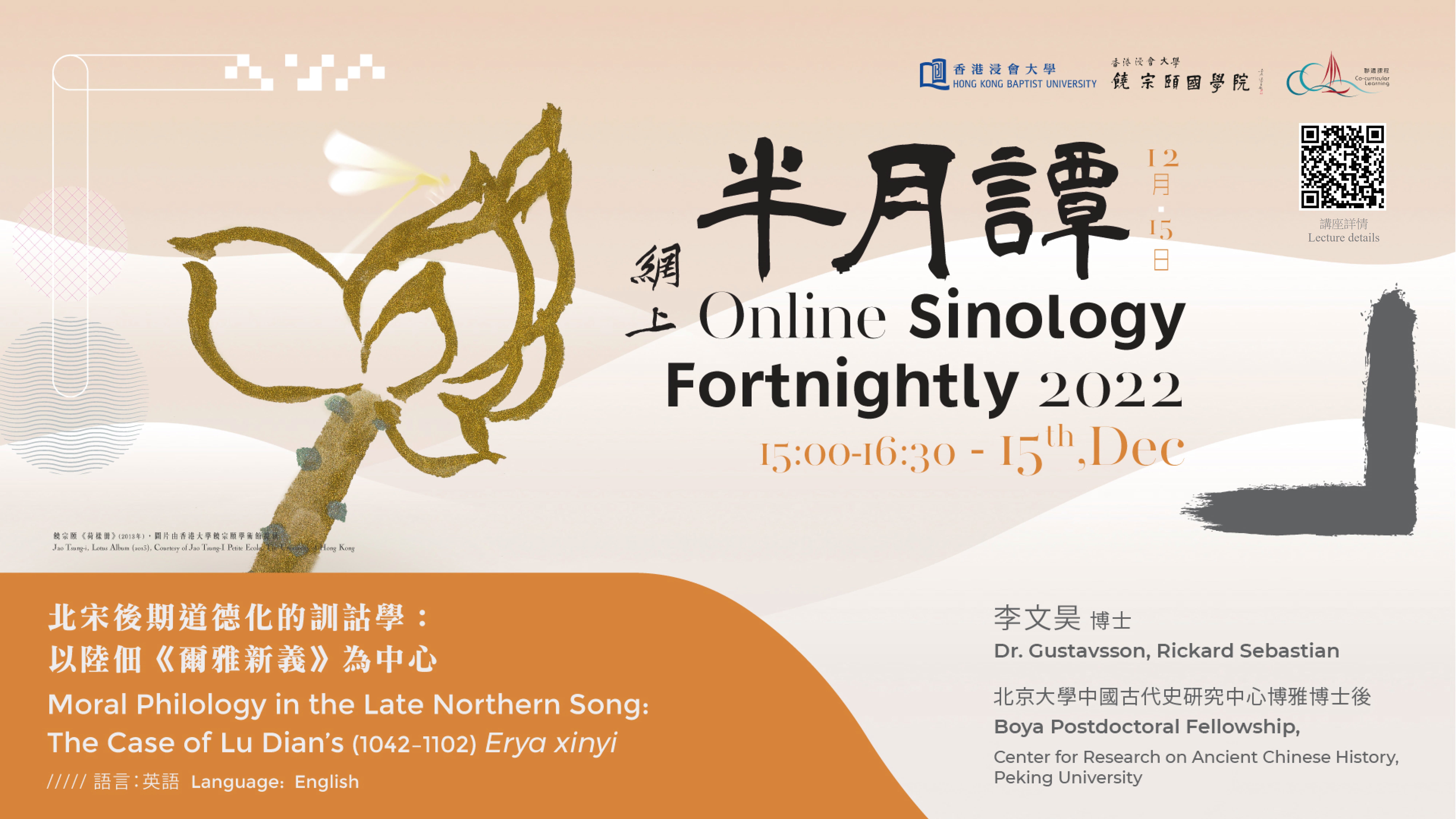

Online Sinology Fortnightly: Moral Philology in the Late Northern Song: The Case of Lu Dian’s (1042–1102) Erya xinyi
15Dec 2022
15:00-16:30
- Zoom
- Dr. Rickard Gustavsson, Boya Postdoctoral Fellowship, Center for Research on Ancient Chinese History, Peking University
Dr. Rickard Gustavsson holds a PhD in Chinese and history from City University of Hong Kong and is currently a postdoctoral fellow at the Center for Research on Ancient Chinese History at Peking University. His academic interests include intellectual history, Confucian philosophy, history of philology and classical studies, and comparative philosophy. In his postdoctoral research, he examines the intersection of hermeneutics, politics, and philosophy in the Northern Song period with a particular focus on the so-called movement of New Learning (xinxue 新學) in the late eleventh and early twelfth century.
Moderator: Dr. Chang Huilin (Postdoctoral Research Fellow of HKBU Jao Tsung-I Academy of Sinology)
Abstract: Eleventh and twelfth century China was a period of great intellectual and social transformations. Scholars in this period began to systematically question previously held standards, which led to a rethinking about the natural world, Confucian scholarship, and the basic principles of governance. The new ways in which people understood the natural world and human values, that grew out of this critical climate, also changed people’s understanding of and attitude towards language and texts. In particular, scholars who were more interested in metaphysical explorations and moral self-cultivation seriously questioned the value of language and turned away from linguistic analyses and literary practices. Yet, others sought to reaffirm the value of language by analyzing Chinese characters in terms of their moral and cosmological meanings. These scholars, represented especially by the Wang Anshi 王安石 (1021–1086) and his followers, found in the Chinese script a graphic system that reveals, in a concise manner, the normative patterns of nature. For them, philology became an essential tool for cultivating knowledge, promoting moral values, and building a system of socio-political order. In this talk, I will discuss this philological method based on Lu Dian’s 陸佃 (1042–1102) Erya xinyi 爾雅新義, in which he transforms the Erya 爾雅 from a philological text that glosses the meaning of words in the Confucian classics to a text on morality and cosmology.
No registration is required for this lecture series. All are welcome to attend each lecture with the following Zoom meeting details:https://hkbu.zoom.us/j/95590069728?pwd=VzVjWWxkUndYL2FHaVZucml5bWpFdz09
Zoom Meeting ID: 955 9006 9728
Password: 537362
HKBU students: For CCL attendance, please (1) register via SLES before the activity, (2) log in Zoom using HKBU email account, with your name as "STUDENT ID NO. + NAME", and (3) complete and submit the Co‐curricular Learning Evaluation Form after the activity in 3 working days.