

Climate and environmentally conscious urban expansion offer a dual solution for managing urban heat and air pollution
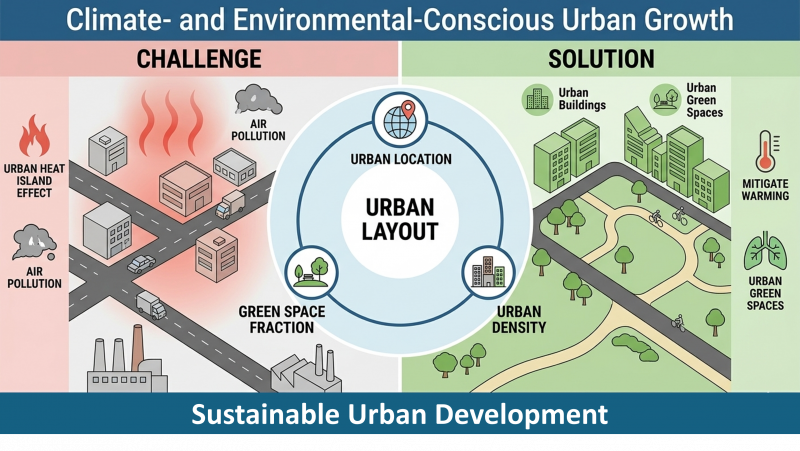
As cities expand, changes in surface properties and increased anthropogenic emissions intensify both urban heat and air pollution. To improve resilience, cities have implemented a Green-Blue-Grey Infrastructure (GBGI), integrating vegetation-based (green), water-based (blue) and engineered (grey) systems. However, while these measures have proven effective in mitigating urban warming and improving air quality, they often require a substantial financial investment and the improvements in air quality and urban warming require a careful assessment.
In a study recently published in the journal Nature Communications titled "Optimized spatial planning offers a dual solution for managing urban heat and air pollution in humid subtropical climates", a research team led by Professor Gao Meng from the Academy of Geography, Sociology and International Studies at HKBU propose a multi-objective optimisation framework for urban development in the Great Bay Area (GBA) to tackle environmental and climate constraints. The framework uses a Non-sorted Genetic Algorithm to generate a set of optimised urban plans for stakeholders to consider, which incorporates more two-way feedbacks between urban heat and air pollution than other multi-objective development optimisation methods, enabling expansion to proceed with minimal impact on air quality and the thermal environment.
The proposed framework demonstrates that optimised development should prioritise locations upwind of the summer monsoon, favour medium-density areas (where the built-up fraction ranges from 0.5 to 0.8), and increase urban green space fractions from 0.15 to 0.27. This layout would yield the greatest reductions in urban warming and pollution, and both regression analysis and numerical simulations confirm the effectiveness of climate- and environmentally conscious urban expansion. Furthermore, numerical simulations confirm that enhanced ventilation improves air quality, while strong southerly winds mitigate heat.
The research also compared green roof and cool roof mitigation with this proposed multi-objective urban development method. The results show that although roof strategies can reduce surface temperatures, they may also degrade air quality by emitting additional Biogenic Volatile Organic Compounds (BVOC) emissions that increase the formation of ozone and aerosols, and by inhibiting the dispersion of PM2.5 and ozone. This comparison indicates that optimised urban development offers a different perspective towards achieving the dual benefits of thermal comfort and improved air quality without incurring substantial retrofitting costs.
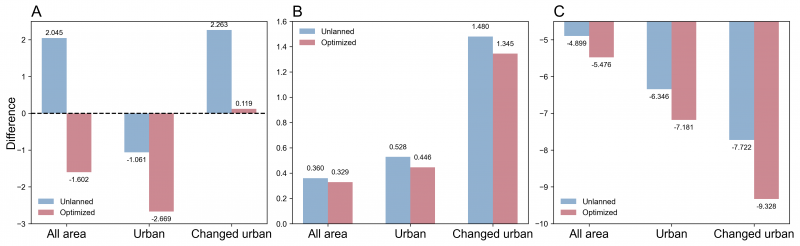
Comparisons of environmental impacts between unplanned urban development and optimised urban development based on numerical simulations
More about Professor Gao's research profile: Meng GAO - Hong Kong Baptist University