

Discovering the hidden markers of authentic Chinese Medicine
.png)
Valuable Chinese medicines have shaped how generations eat, heal, and care for family, but as we move from herbal shops to processed supplements, their authenticity is harder to judge by eye. Professor Simon Han Quanbin is giving the industry a scientific answer – one molecular marker at a time.
Key Impacts:
- Molecular markers for authenticating valuable Chinese medicines: Developed scientific methods to authenticate Dendrobium officinale, Cordyceps, edible bird’s nest and Ejiao—even when processing makes visual identification difficult.
- Quality assessment beyond authenticity: Methods help verify genuine ingredients and assess quality, including a marker that can indicate whether Cordyceps has qualities comparable to better-grade material.
- Commercial testing reveals substitution risks: Testing of 110 commercial Ejiao products found that more than half did not qualify, highlighting the need for reliable authentication.
- Research put into practical use: The technologies were licensed to the Hong Kong Authentication Centre of Valuable Chinese Medicines Limited, which provides testing services to the industry. They are used by more than 15 institutions across the sector.
- Evidence supporting enforcement: In 2022, the Hong Kong Customs and Excise Department asked Professor Han’s team to authenticate intercepted Cordyceps shipments. The team’s reports were used as evidence in legal cases to help distinguish legal from illegal sales.
- International recognition: Professor Han’s project received gold medals at the First Asia Exhibition of Inventions Hong Kong and the 2021 Geneva International Exhibition of Inventions.
In a market survey conducted by the Hong Kong Authentication Centre of Valuable Chinese Medicines, around 60 per cent of respondents believed the quality of traditional Chinese medicines on the market is highly inconsistent. More than 85 per cent agreed that scientific methods are needed to address problems in Hong Kong’s valuable Chinese medicine market, yet only around 30 per cent said they pay attention to third-party testing when making purchases.
HK Authentication Centre of Valuable Chinese Medicines, founded by Professor HAN and students
from HKBU’s School of Chinese Medicine, uses advanced technology to quickly and accurately verify
prized herbs like Cordyceps, Dendrobium, and bird’s nest.
That gap says a lot about the state of the industry. Consumers are well aware of the variable quality, and they recognise the need for scientific testing, but this does not yet necessarily change the way they buy. Many still rely on the familiar signals of trust – the neighbourhood shop, brand, recommendation from a relative. Han’s research does not dismiss these, but it does give them a more solid base.
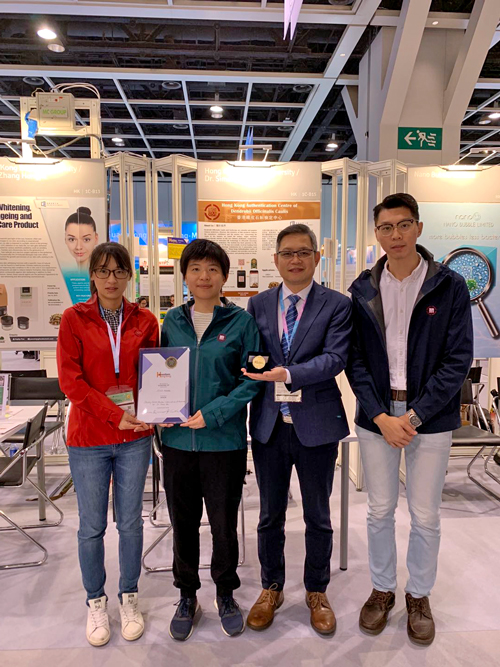
"Quality control markers for use in herb authentication" project has won Dr. Han a gold medal at the First Asia Exhibition of Inventions Hong Kong [Photo courtesy: HKBU Foundation]
A product may look legitimate and have the right name, but still be adulterated or contain lower quality substitutes, and this is the problem Professor Simon Quanbin Han has spent years trying to expose. At Hong Kong Baptist University’s School of Chinese Medicine, his research applies analytical science to a question that has become increasingly important for consumers, retailers and regulators alike: how can valuable Chinese medicines be authenticated when their appearance and reputation can only go so far?
The answer is to look for proof within the medicine itself. Genuine ingredients have chemical signatures that substitutes do not share known as molecular markers, which may appear in complex sugars, or in smaller sugar or protein fragments, depending on the medicine. While they are not visible to a normal customer, in the laboratory they may show what a product really contains.
Valuable Chinese medicines have a long history of use, but history alone cannot protect consumers in a modern market. Our work gives the industry scientific tools to maintain the confidence that people already place in these products.
Professor Simon Han
Han’s team are not simply looking for a way to spot a fake. They want to find a way to read valuable Chinese medicines more closely, especially when the usual signs of quality are no longer visible.
In medicines such as Dendrobium officinale and Cordyceps, some of the most telling clues are in polysaccharides, complex sugar molecules closely linked to the nature of the ingredient, but difficult to analyse in a routine quality control. By refining ways to identify these molecular features more clearly, Han and his team developed a methodology to confirm whether a medicine is genuine and to assess the quality that buyers and practitioners care about.
That distinction matters because authenticity is rarely a simple yes/no question in Chinese medicine. A product may be real, but its quality and composition can still vary widely. The team developed a faster method to identify genuine ingredients and evaluate Dendrobium officinale. For Cordyceps, they found a marker that could help show whether a sample had the same qualities as better material. Research therefore moves beyond authenticity alone and towards quality: whether a product lives up to its worth, confidence, and price tag.
Edible bird’s nest may begin as a dried nest, but it is also sold in bottled drinks and supplements where the original form is undetectable. Ejiao, traditionally made from donkey hide, faces a different problem as cheaper animal gelatins can be passed off as the real thing. Here, Han's team applied the same principle, identifying markers that could authenticate edible bird's nests quickly, and using protein fragments to trace the animal source of Ejiao. In one study, the team tested 110 commercial Ejiao products, and found that more than half did not qualify, a sobering result for a product sold on the strength of its purity.
The value of this work lies in what happens after the methods are developed. Authentication is only relevant if it can be used outside the laboratory by people making decisions that dictate what is sold on the market. Professor Han’s technologies have since been licensed to the Hong Kong Authentication Centre of Valuable Chinese Medicines Limited, which was co-founded by the HKBU faculty and students, and whose research has become a practical testing service for the traditional Chinese medicine industry.
For businesses, this matters because authenticity affects reputation as much as quality. The technologies are used by more than 15 institutions across the valuable Chinese medicine sector, from established companies to wholesalers and collaborators.
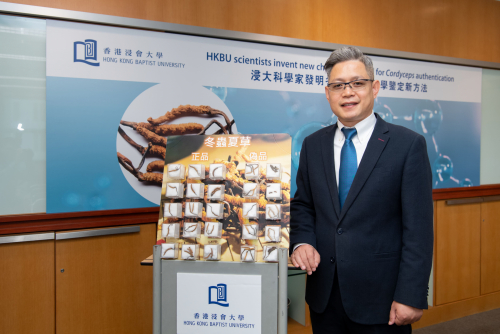
Authentication becomes even more essential when a product is the subject of a dispute. In 2022, the Hong Kong Customs and Excise Department asked Professor Han to authenticate intercepted Cordyceps shipments. Testing reports written by the team became irrefutable evidence in legal cases, distinguishing between legal and illegal sales. “The value of authentication is not only in detecting what is false,” says Professor Han. “It is also in protecting what is genuine, so that responsible businesses can be identified and consumers can make decisions with greater confidence.”
Professor Han’s research profile: Simon Q B HAN - Hong Kong Baptist University